|
Vintage Goods You're Probably Under-Pricing   Flying Under The "Collectible" Radar New York - Every weekend, thousands of homeowners haul boxfuls of inherited clutter to local yard sales or dumpsters, operating under the assumption that if an item isn't a fine 18th-century antique or an iconic Mid-Century Modern designer piece, it’s virtually valueless. While most people now recognize that high-end Mid-Century furniture commands big money, decorative arts authorities and seasoned auctioneers caution that many ordinary, non-designer household goods produced between the 1930s and 1980s are quietly generating just as much excitement.  "The modern secondary market isn't just driven by age - it’s driven by material quality, nostalgic demand, and unexpected scarcity," explains veteran estate appraiser and decorative arts consultant Timothy Hanson. "People routinely clear out estates assuming mid-century plastics, utilitarian kitchenware, or costume accessories are disposable because they aren't 'signed' designer furniture or decorative arts pieces, when in reality, sharp-eyed collectors are actively fighting over them," he says. So, before you decide to price your estate leftovers for a dollar apiece, you might want to keep an eye out for these five household objects that could be worth a small fortune. 1. Pre-1950s Catalin & Colorful Phenolic Radios While heavy, dark Bakelite radios from the 1930s remain common trade staples, their vibrant, cast-phenolic siblings known by trade names like Catalin can command extraordinary prices at auction. Produced during the late Depression era in striking translucent hues of turquoise, marbleized maroon, and butterscotch, these radios were expensive to make and prone to structural cracking. "Because Catalin required an intensive casting process and chemical finishing, production runs were relatively short," notes decorative arts historian Dr. Charles Gregory. "Today, a tabletop Catalin radio with its original housing intact and untrimmed can easily command anywhere from $800 to over $3,500 depending on color combination and condition."  Pre-1950s Phenolic Radios 2. Pre-War Cast Aluminum Kitchenware & Mechanical Gadgets While vintage Pyrex and enamelware have entered mainstream collecting, 1920s to 1940s heavy cast aluminum kitchen items remain a hidden niche. Early mechanical gadgets such as Griswold cast-aluminum waffle irons, heavy hand-crank citrus juicers (like the "Juice-O-Mat"), and ornate art deco ice crushers are frequently tossed into $5 yard sale boxes because buyers often mistake them for discoloured old scrap metal devices with little value. "Most people associate high-value vintage kitchenware with brightly colored glass, but early cast aluminum pieces represent early industrial art," says Norridge auctioneer David Tate. "An unusual 1930s Griswold heart-shaped aluminum waffle iron with its original frame can easily fetch $400 to $900 at one of our sales," he says, "with collectors looking specifically for heavy gauge metal, intact wooden handles, and polished Art Deco geometric lines."  Vintage Juicers 3.High-Quality Vintage & Unmarked Costume Jewelry While pieces with famous maker’s marks are easy to spot, many of the most lucrative costume jewelry finds in estate boxes bear no signature at all. During the mid-20th century, top-tier manufacturers produced unbranded lines for department stores, while smaller European makers imported exquisite hand-set pieces into the market without stamps. According to vintage jewelry specialist Damien Marcus, "Sharp collectors look past the lack of a signature to focus on craftsmanship - heavy gold-tone plating, prong-set rhodium backings, unfoiled crystals, and thick Lucite accents. Unsigned 'Jelly Belly' animal pins from the 1940s or unsigned German and Czech glass brooches can easily fetch $300 to over $1,000 online. Never assume an unmarked piece is costume junk."  1940s Jelly Belly Penguin Pin 4. Molded 1960s Fiber & Lucite Executive Desk Accessories Before cheap injection-molded plastic dominated office spaces in the late 1970s, executive desk accessories from the late 1950s, and particularly the 1960s, were crafted as miniature architectural sculptures. Desk organizers, perpetual calendars, pen holders, and paperweights made by designers and makers like Peter Pepper Products, Park Sherman, and Danese Milano incorporated heavy cast metals, embedded Lucite specimen blocks, sculpted walnut, and colorful molded fiberglass. "Executive office goods from this era are routinely disposed of during "boomer' home office clear-outs," notes commercial design archivist and appraisal consultant Helena Rostova. "Yet interior designers and late twentieth-century enthusiasts aggressively hunt for these pieces to style high-end workspaces. An unusual 1960s Peter Pepper Products molded fiberglass desk organizer or an Art Deco-inspired Park Sherman perpetual calendar in mint condition can quickly sell for $350 to $1,200."  1960s Peter Pepper Paper Tray 5. Architectural Novelty Clocks & "Kitchen-Prantics" Electric wall clocks and novelty mantle timepieces from mid-century manufacturers like Sunbeam, Seth Thomas, and Lux have become high-demand accent pieces for interior designers. Distinctive kitchen clocks featuring molded plastic housings, atomic-era geometry, or starburst brass motifs are particularly desirable. "In the 1950s, these were $5 plastic appliances," says auctioneer Tate. "Today, an original 1950s George Nelson 'Ball Clock' or a pristine Sunbeam 'Waterfall' kitchen clock in a rare color like turquoise or flamingo pink can fetch anywhere from $150 to $2,000."  George Nelson Ball Clock The Appraiser’s Rule of Thumb Estate appraiser Timothy Hanson says that while he knows not everything in "basement box-lots" are full of hidden treasures, he still recommends that before donating or pricing any estate sale items, clients should inspect every piece for maker marks, study the density and construction of materials, and consult recent sold listings rather than mere 'asking' prices. Learning to identify these overlooked items he says can be the first step toward people turning estate clutter into some serious revenue. AIA Saff Writers l Editors  NOTE: For readers seeking more information about the Asheford Institute Of Antiques distance-learning program on professional-level appraising, the study of antiques, collectibles, vintage and mid-century modern items, please visit the school's Home Page at www.asheford.com.
Should you have additional questions about the Asheford program, you can also write to the school at: info@asheford.com or call the Registrar's Office toll-free at: 1-877-444-4508. Industry Analysts Look Back At Predictions  1980s Post-Modernism Gains Traction New York — While many collectors view antiques through a lens of nostalgia, seeing them as bridges to the artistry of previous generations, professionals in the trade understand that the market is actually driven by pinpointing the specific historical echoes that resonate with contemporary tastes. Identifying these shifting preferences requires more than just a feeling; it demands data. To analyze the movements that have shaped the market this past year, researchers at the Institute consulted with prominent curators, design authorities, gallery owners, and veteran antique dealers to get their take on six vintage and antique categories that have proven to be box-office standouts in 2026. 1. The Brutalist Revival While some of the original trend predictions followed the forecast, others arrived as a complete surprise—most notably the massive surge in demand for the raw, unrefined, and deeply textured aesthetic of mid-century Brutalist furniture. Celebrated for their "honest" use of materials like jagged metal, heavy oak, and poured concrete, these pieces offer a sharp, architectural contrast to the softness of modern interiors. "We are seeing a move away from the delicate toward the substantial," says Tori Holloway, a London-based dealer specializing in post-war design. Holloway notes that a Paul Evans 'Argente' chest recently fetched a premium at auction, signaling that collectors are now prioritizing the "sculptural weight" of Brutalism to anchor contemporary spaces.  Brutalist Pieces Fetching Record Prices 2. The Chrome Renaissance: Cool Tones Return Move over, brass and gold! The warm metallic dominance of the last decade is giving way to the sleek, futuristic shimmer of vintage chrome and polished steel. Echoing the "Space Age" glamor of the late 1960s and 70s, silver-toned furniture is making a bold comeback. "Chrome offers a crisp, clean aesthetic that plays beautifully with light," says Elena Dimitriov, owner of Silver Horizon in Chicago. Dimitriov reports that cantilever chairs by designers like Milo Baughman and chrome-based "Sputnik" chandeliers are moving faster than she can stock them. "The shift toward 'cool' metals is unmistakable," she adds, noting that younger buyers are particularly drawn to the industrial-yet-chic vibe of 1970s Italian steel.  1970s Chrome Lighting 3. "Brown Furniture" and the English Country House Style The long-awaited return of traditional 19th-century "brown furniture"—mahogany, walnut, and cherry—is finally here. Driven by the "English Country House" aesthetic and a rejection of flat-pack minimalism, collectors are once again valuing heavy patinas and ornate joinery. "There is a renewed appreciation for pieces that look like they have a history," says Julian Hart, a specialist in Regency-era antiques. Hart explains that while "brown furniture" was overlooked for years, prices for high-quality chests of drawers and library tables are rising as decorators seek to add warmth and "heritage" to modern homes.  "Brown" Furniture Returns 4. 80s Post-Modernism: Sleek And Bold The funky, geometric spirit of the 1980s Post-Modern movement is hitting the mainstream once again. Think black lacquer, glass brick, and primary-colored accents. "We've moved past the 'kitsch' phase of the 80s into a serious appreciation for the era's avant-garde design," says Sarah Miller, a San Francisco-based vintage curator. Miller points to the increasing rarity of Memphis Group-inspired lighting and sleek, oversized modular sofas as proof. "Buyers aren't just looking for nostalgia; they want the bold, architectural statements that define 1980s luxury," she notes.  1980s Post-Modern Movement Hits Its Stride 5. Surrealist & Whimsical Decor Many dealers also noted a move towards "conversational" antiques, items that are surreal, whimsical, or even slightly eccentric. From trompe l’oeil ceramics to Fornasetti-inspired motifs and oversized decorative objects, buyers are looking to inject personality into their collections. "People want to be surprised by their decor," says Chloe Dupont, an antique specialist in Paris. Dupont explains that this trend favors the unique and the strange over the mass-produced. "Whether it’s a set of monkey-themed candle holders or a surrealist clock, if it starts a conversation, it’s a winner in the current market," she says, noting that these "curiosity cabinet" items are becoming essential for a truly curated home.  Trompe L'oeil Asparagus Tureen 6. The Americana Surge: 1776 Revival With the United States recently celebrating its 250th anniversary (the Semiquincentennial), early American primitives and folk art are also experiencing a patriotic revival. Interest in pre-industrial craftsmanship, such as hand-painted weather vanes, early quilts, and colonial-era stoneware is at an all-time high. "The 250th milestone has sparked a deep curiosity about our material history," says Samuel Davidson, a dealer specializing in Americana. Davidson notes that authentic 18th and early 19th-century pieces are being snapped up by a younger generation of "Modern Traditionalists" who want to celebrate the nation’s heritage through tangible, handcrafted objects.  Rise In American Patriotic Items As with any speculative market, predicting decorative arts trends that are going to stick for more than a year can be a difficult proposition at the best of times, with the most successful antique and vintage dealers often being those who can balance research with their own professional intuition. By anticipating these aesthetic cycles, dealers can often strategically align their inventory with the evolving tastes of a modern audience. And, if a particular trend doesn't happen to have hit its peak this season—well, in the world of antiques and collectibles, you can rest assured that a new "forgotten" era is always just around the corner. A.I.A. Staff Writers NOTE: For readers seeking more information about the Asheford Institute Of Antiques distance-learning program on professional-level appraising, the study of antiques, collectibles, vintage and mid-century modern items, please click here to visit the school's Home Page.
Should you have additional questions about the Asheford program, you can also write to the school at: [email protected] or call the Registrar's Office toll-free at: 1-877-444-4508. Funny Meme's Of The Show  Making Light Of The Roadshow New York - We've covered this story in the past, but it would seem that our friend Keaton Patti is up to his old tricks again when it comes to spoofing the iconic Antiques Roadshow nameplate. As we're sure everyone is aware, the Roadshow has been responsible for handing out informative and on-air appraisals about rare and unusual antique and collectible items for many decades now. The show's incredible popularity has spanned the globe with various clones of itself popping up in Canada, Sweden, Australia, and of course the USA. However, it wasn't until an Internet meme artist started having some fun with the classic "valuation still-shot" at the end of each segment that the show finally hit its full Internet potential with photoshop specialist and salient meme humorist, Keaton Patti taking legitimate freeze-frame photos from Roadshow appraisals (shown above), and turning them into fake one's for our viewing pleasure (shown below). So, without further ado, here are a few of what we think might be some of the funniest fake appraisal memes of the Antiques Roadshow that we've ever seen... Antiques Roadshow Memes: 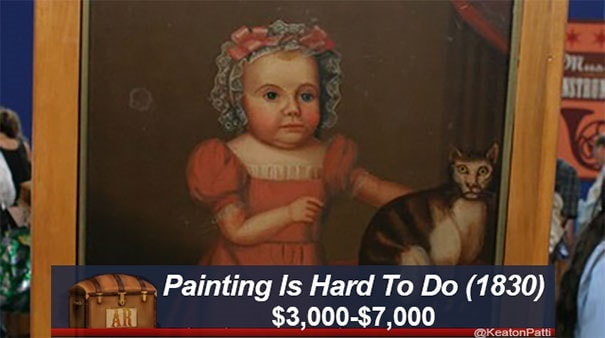 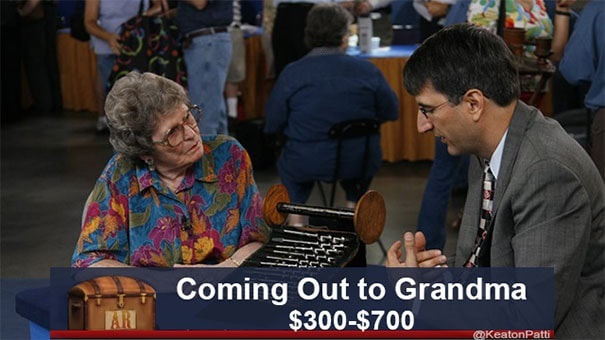 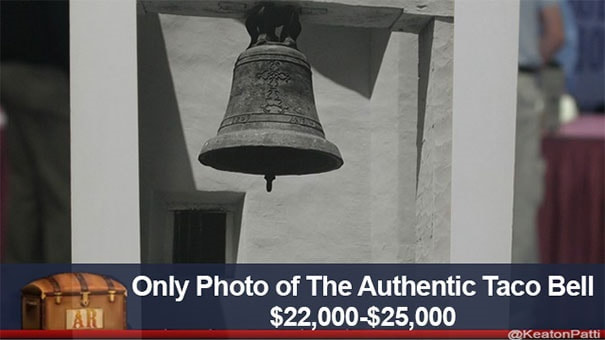 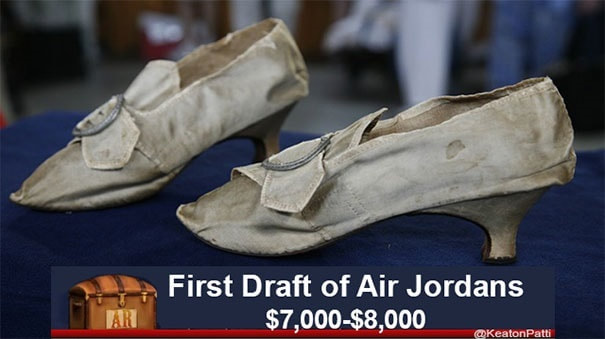 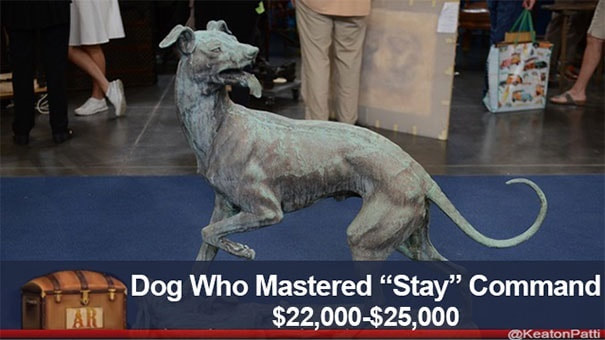 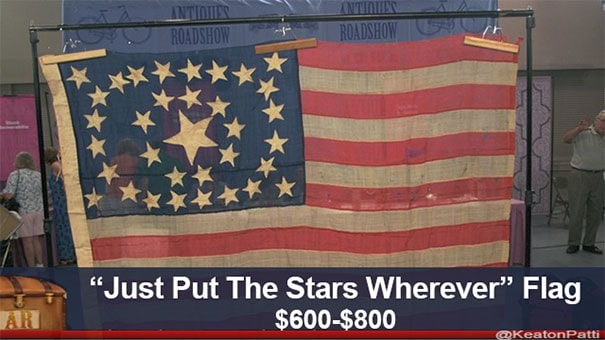 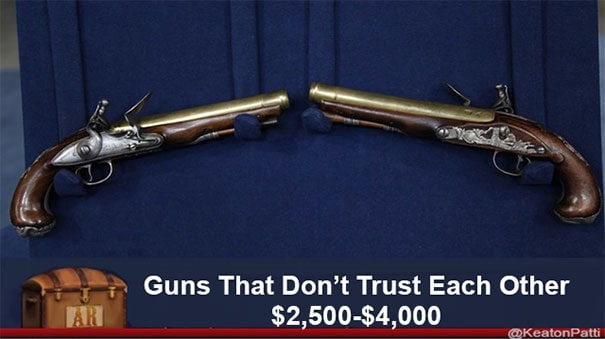 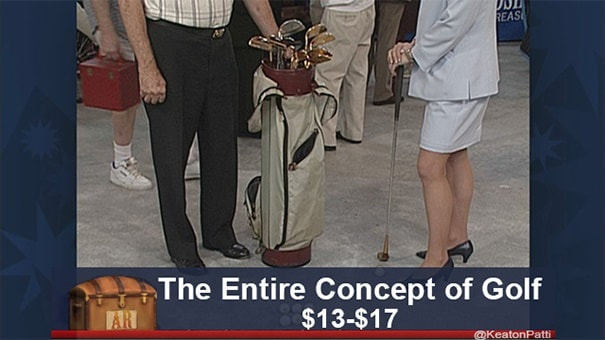 There are of course many more of these types of memes online (not all "G" rated however), but we thought these eight particularly represented the ethos of the Roadshow quite well, while simultaneously giving a wee chuckle. However, if you've managed to come across a few more you think should also be included, or have one yourself, please let us know, and we'll be happy to take a look for our next go around! - A.I.A. Staff Writer's  NOTE: For readers seeking more information about the Asheford Institute Of Antiques distance-learning program on professional-level appraising, the study of antiques, collectibles, vintage and mid-century modern items, please click here to visit the school's Home Page.
Should you have additional questions about the Asheford program, you can also write to the school at: [email protected] or call the Registrar's Office toll-free at: 1-877-444-4508. |
AIA StaffWe're providing our students and reader's with the latest breaking news on events and happenings that we think might be of interest to both collectors and dealers alike. Including changes within the world of antiques, vintage, collectibles and appraising that might just have an effect on your bottom line. We're also interested in hearing from you - so if you've got a great newsworthy story, let us know, and you just might find it here! Archives
October 2026
CategoriesLegal Disclaimer: Extraneous opinions, statements and comments made by individuals represented within these posts do not necessarily reflect those of the Institute. The publication naming of specific business entities, organizations, and concerns, contained herein, in no way represents an endorsement or recommendation of services or products by the Institute. Publicly identifiable information contained herein (including, but not limited to contact information), has been intentionally limited where possible, due to privacy and legal concerns related to the digital dissemination of information through online means. All views expressed herein are those of their respective owners. The Institute is in no way responsible, financially or otherwise, for the accuracy or validity of statements contained within published posts from sources that originate and appear outside of the written and expressed views of those submitted by the Institute.
|
 RSS Feed