 New York - As the Covid economy continues to cycle people in and out of lockdown, a new breed of antique and vintage collector/dealer has begun to emerge from the shadows of self-isolation and quarantine. Freshly minted collectors who've been attempting to hone their garage and estate sale 'hobby picking' skills into something more profitable and professional, while working patiently from home over the last few months, are suddenly beginning to make their presence felt within the decorative arts scene. Armed with beginners enthusiasm, and a few months of pandemic-induced online searches under their belt, these nascent collectors, cum dealers, are the antique world's answer to the frenzied day-traders of the Robinhood investment firm. However, as with most new-to-market experiences, there are usually growing pains, and this latest batch of freshly-baked dealers are finding out that they're no exception to the rule. Roger Crozier, a longtime seller of musical memorabilia on eBay from San Francisco says that after about a month of lockdown, he started to notice a change in the number of queries he was getting regarding his online items and how they were listed. "It was strange," said Crozier, "Normally I'd just get the usual listing questions, but by early spring I was receiving emails from people who were more interested in how I got into the antique business than the item itself." Crozier said that many of his other online colleagues also seemed to notice an uptick in requests by people who were simply inquiring about how to sell antiques online. For those who are just starting out, or may be entering the antique and vintage field due to a piqued curiosity brought about by an extended home layover from the Coronavirus, the learning curve for buying and selling can be steep. Jessica Smith, who's been a vintage photography dealer on eBay for over fifteen years says that it takes time to learn the ropes. "Most mistakes I'm seeing by recent buyers are easily correctible, but you need a check list of do's and don'ts - and what I'm noticing from these new dealers and collectors is a lot of don'ts." Smith says that the most common errors she encounters on eBay relate to basic research. "Don't be afraid to ask the seller questions before buying. Examine photos carefully for any signs indicating a fake or reproduction, such as lack of wear and usage, and look to see if the seller has multiple listings for similar items - a telltale sign of mass production." In addition to these simple offerings Smith also says that buyers should be asking about any noteworthy condition issues, as this will help the purchaser should the item need to be returned because it was misrepresented during the sale. 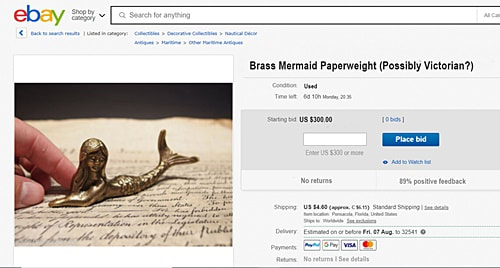 "Poorly Described & Overpriced Is Common," Says Hardy "Poorly Described & Overpriced Is Common," Says Hardy Smith thinks that some of the freshly-sprouted dealers might also be shortchanging themselves on a lack of comparative price checks. "Look at realized pricing from all over the Internet - if a price seems too good to be true, it probably is," says Smith, "which means you should adjust your bidding strategy accordingly." Smith also noted that if you're bidding on an item that comes with a signature or manufacturing mark on it, make sure you're familiar with these renderings and their meanings before purchase, since they can have a big impact on determining authenticity and overall value. Lastly, you need to check the sellers reputation by going through their feedback, says Smith. "It's really pretty simple, but you'd be surprised how many new collectors don't fully vet their online purchases before hitting the 'buy' button." For Derrick Hardy, who deals primarily in small nautical antiques from his shop in Halifax, Canada, the change in eBay listings was noticeable. "I buy and sell almost exclusively online, so when I started seeing an influx of listings with items being misrepresented, along with poor photos, and over-the-top prices, I started to get a little concerned." Hardy freely admits he didn't initially make the connection between the stay-at-home timeline and the spate of new dealer listings until he started to examine their selling history. "Over time I realized that many of these dealers had just started listing within the last few months." Being a successful online seller also requires its own checklist, says Hardy. "Comparing similar items and verbiage used before posting an item on eBay is paramount - it gives you an idea of how to construct your own listings." Hardy said he also noticed a slew of other mistakes from the springtime postings such as improper titles, or listings without relevant keywords, and photos that didn't accurately represent the item being sold. "Little things like not putting in a reserve bid or ending an auction early are all bush-league mistakes," said Hardy, "In the end, prep-time pays off." While the majority of longtime online dealers and collectors would likely agree that adding new blood to the decorative arts community is certainly a positive step in the right direction, many are also likely to acknowledge that this fresh resurgence of interest in the antiques and vintage field by neophyte dealers and collectors is likely to be short-lived, unless there's a serious reckoning of homework first, with 'listings' to follow... - A.I.A. Staff Writers  NOTE: For readers seeking more information about the Asheford Institute Of Antiques distance-learning program on professional-level appraising, the study of antiques, collectibles, vintage and mid-century modern items, please click here to visit the school's Home Page.
Should you have additional questions about the Asheford program, you can also write to the school at: [email protected] or call the Registrar's Office toll-free at: 1-877-444-4508  New York - For many, especially during the time of Covid, it may come as somewhat of a surprise to think that today's Millennial generation could be having some kind of meaningful impact on economic issues related to the decorative arts, however, a recent international survey of this groups online habits related to antiques, art and vintage buying trends, may finally be putting this old refrain of a lost and directionless generation to rest for good. According to the latest analysis on the fiscal state of today's decorative arts industry ("The Market Report 2020"), released by Art Basel and UBS earlier this year found that Millennials were the most active online collectors of any demographic group, and currently make up almost half of all global collectors, according to the survey's author, Clare McAndrew. Besides just the raw numbers, McAndrew also noted in her study that millennial collectors were also the most active consignors when it came to placing items up for sale with online auctions, with over seventy-percent saying they’d resold items from their collections (compared to just one-third of boomer collectors). The frequency with which millennials turned over items in their collections was also highlighted in the report, indicating that millennials, unlike boomers, also seemed to be more interested in making short-term capital gains on their decorative art collections, rather than holding and hoping for long-term growth. McAndrew also commented on millennials motivation for buying in the first place. "Everybody says I buy it for passion, and things like that, but when you look at their actual behavior, they’re getting in and out of the market pretty quickly.” she said. “They’re acting very financially for being so aesthetically motivated.” While the Basel report is perhaps the strongest and most recent indicator yet of a resurgent interest in the world of antiques and the decorative arts by a new generation of collectors, it is by no means the first signpost to signal such a dramatic change in collecting behavior. Anthony Harper, lead researcher for the Asheford Institute's own poll and yearly survey of top trends within the antique and vintage community, said he began noticing the age shift a couple of years ago. "We started getting our questionnaires coming back from dealers and antique malls indicating a much younger demographic than in the past," said Harper. "Even today, in the midst of the Covid pandemic, many dealers are reporting that the lion-share of their sales are not only coming online, but from millennials as well."  Millennials Have Become Consistent Clients For Many Dealers Millennials Have Become Consistent Clients For Many Dealers For Timothy Pike, a pop-up dealer and picker from the South, who was featured in the school's Antiques For Millennials article from last June, the whole process has continued to evolve. "Last year I was selling lower-end Victorian furniture to these folks," he said. "Today some of these same people are back, except this time with an emailed laundry-list of higher quality items they're hoping I can pick for them." Pike believes that despite the millennials adeptness at online tasks, there are just some things he's better suited to doing. "I'll do the real-world rummaging," he said, "and leave the Internet sleuthing to the kids - as long as they're paying for my time - I'm fine with that." Karen Risener, an online dealer from Seattle, who's also a millennial, says she's read the ART Basel report and agrees with many of its conclusions. "I don't even structure my inventory towards baby boomers anymore," said Risener. "They're no longer buyers - they're sellers." Risener said she thinks her generation has a special connection with things from the past, and that's part of the reason why antique and vintage dealers are seeing increased sales from her demographic. Predicting interest in the future direction of the antiques and vintage marketplace can be difficult enough in an ordinary year - without a pandemic - but add to that shop closures and a shortened retail season due to the shut-downs, and suddenly having a few "spend-happy" millennials in your corner can start to look pretty good, especially when the sales are online. Whether millennials remain long-term collectors and replace the famous boomers who fed and nourished the antique and collectible industry like no other during the roaring 1970s and 80s remains to be seen, but at least we now have some solid evidence that this once seemingly lost generation may have finally found a purpose that we can all invest in... - A.I.A. Staff Writers NOTE: For readers seeking more information about the Asheford Institute Of Antiques distance-learning program on professional-level appraising, the study of antiques, collectibles, vintage and mid-century modern items, please click here to visit the school's Home Page.
Should you have additional questions about the Asheford program, you can also write to the school at: [email protected] or call the Registrar's Office toll-free at: 1-877-444-4508 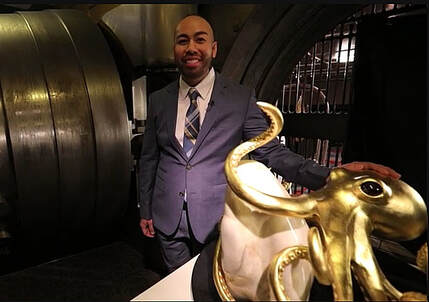 Abraham Reyes Stands Next To The Family Pearl Abraham Reyes Stands Next To The Family Pearl Toronto - Finding positive news can often seem like a somewhat daunting task during these unsettling times. However, out of every crisis often come tales of hope and promise that can move us forward to a better place. Such is the story of a fisherman, an antique collector, and a family's recent unveiling of a pearl that may be the world's largest and most valuable ever found to date. While the tale of this generational jewel may not reference the long-lost pearl from the legend of Lao Tzu exactly, it is nevertheless likely to be the closest companion piece to the storied fable that you'll ever see. In fact, the recently unveiled pearl was apparently discovered in the very same waters off the coast of the Philippines as the famous Lao Tzu gem. Flash-forward almost a hundred years from this legend, and a Canadian man from a suburb just outside of Toronto, has recently unwrapped a family heirloom that is now believed to be perhaps the world’s largest natural pearl, weighing in at just under 60 pounds, with an estimated auction value of between $65 to $95 million dollars. The pearl which comes with a long and colorful family history, was on display for the unveiling outside a vault with the current owner Abraham Reyes, a Mississauga, Ontario man, who inherited it from his great aunt. The off-white pearl which is about the size of a cows head, or baby, is encircled by a 22 carat gilded octopus which holds it in place. The pearl itself is estimated to be about a thousand years old, and possibly much older. Reyes told reporters at the unveiling that he first saw the pearl when he was very, very young. "I was around seven years old,” Reyes said, “But the value of those things never played in my mind at the time.” 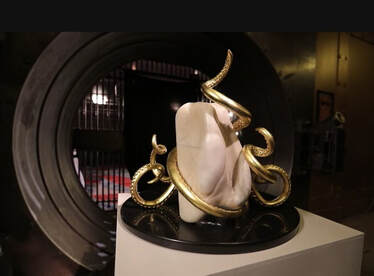 Gilded Octopus Holds Pearl In Place Gilded Octopus Holds Pearl In Place Experts are still pouring over the pictures and further examinations have to be completed, however, assuming everything pans-out as presented, then the pearl would far outweigh the infamous Pearl of Lao Tzu, which rings in at a speck over 15 pounds, and has long been considered the world's record-holder. (Notwithstanding the purported - but as of yet - not fully substantiated catch of an even larger pearl caught by a Filipino fisherman a few years ago). Reye's says that he gets his interest in old things and gems honestly as they were both areas of personal interest that were passed on down to him by his great aunt. According to Reyes, his aunt, who lived in Manila, was an avid and renowned collector of oriental art, pre-colonial antiques, and sea related artifacts, including rare shells, and enjoyed sharing her passion with Reyes. His aunt received the pearl from Reyes Grandfather who suitcased it into Canada in 1959, after acquiring it from a local fisherman (both of whom apparently had no idea of its value at the time), before it was eventually passed onto Reyes as part of a collection of family heirlooms. In fact, Reyes claims that he and the rest of the family didn't even know it was a pearl until just a few years ago when someone suggested they have it examined by the Gemological Institute Of America. Reyes says that what's funny is when people used to see the pearl in his house, they often thought it was simply a fancy sea-sculpture of an octopus with tentacles encasing a rock, "They literally had no idea it was a pearl," he said. "But then again, just prior to that... neither did I." When asked about the prospect of bringing it to auction, Reyes stated that it would stay in the family, but that he would like to see it come out of the vault more often. “My goal is to have it brought to the museums or even some of the major galleries for the world to see it,” Reyes said. He wants to teach the public about preserving antiquities, along with the history of pearls, why they're so valuable, and the need for raising environmental awareness. “Natural pearls are a reflection of our delicate ecosystem,” he said, "We need to protect all of it." For the rest of us, this is clearly an educational tale of why it pays to be nice to your elderly relatives! - A.I.A. Writers  NOTE: For readers seeking more information about the Asheford Institute Of Antiques distance-learning program on professional-level appraising, the study of antiques, collectibles, vintage and mid-century modern items, please click here to visit the school's Home Page.
Should you have additional questions about the Asheford program, you can also write to the school at: [email protected] or call the Registrar's Office toll-free at: 1-877-444-4508  Not A One-Size Fits All Solution Not A One-Size Fits All Solution Florida - For some antique and vintage dealers the arrival of the global shutdown may merely seem like yesterday's news, but to others the Coronavirus close-out of storefront business traffic has felt more like an eternity than a brief hiatus from work - especially when it comes to a company's balance-sheet. However, in recent days, a number of states and provinces across North America have either opened fully (like Georgia), or have started ramping up measures aimed at bringing their local economies back online. In Alabama, the state has allowed businesses to resume many normal practices beginning the first of May, while in Canada, the Province of British Columbia is preparing a staggered reopening for sometime later the same month. While these measures can 'hopefully' be seen as an encouraging sign that we may be moving in the right direction when it comes to ending the Coronavirus pandemic, it certainly has to be weighed with a degree of caution against a premature opening that might set us back again to where we were just three short weeks ago. When school staff writers reached out to a number of antique and vintage dealers across the continent to discuss the implementation of these new measures, it came as no surprise that there was a certain amount of trepidation from local business owners over how to proceed, along with some mixed feelings on the opening process itself. Tim Clark, a semi-retired dealer from Birmingham, Alabama who owns a small storefront with mixed hours, said that he doesn't really see much of a problem when it comes to his own shop. "I'm only open part-time as it is," said Clark, "So without the lineups that you see in box-stores, I really don't anticipate having any problems with physical-distancing since there aren't usually that many folks in the store at one time anyway." Clark says he's more concerned about just getting people out to buy. "You can be open all you want, but if no one's leaving the house it won't do you much good." For others in the business it's more a concern. Janet Williams, who manages an old red-brick grainery converted into a large antique and vintage storefront in rural southern Georgia says that it's simply about crowd control. "We're often slammed on the weekends," says Williams, "I can't honestly say that I can be two places at once in this huge space while trying to maintain social-distancing between folks who are shopping." Williams feels that her job is important, but she's not sure if she wants to risk everything on having to police customers about safe behavior during the pandemic. "I'm sixty-three," says Williams, "I'm right in the sweet-spot for the virus to do some damage, so I'm really going to have think about this carefully before deciding on whether or not to come back into work." While many of the governors of the states that are either open, or soon to be open for business are claiming that the roll-outs are being conducted based on scientific data, these claims themselves seem to be in stark contrast to the health and scientific recommendations being made by other government officials and scientists. "It's confusing as hell," says Harold White, a dealer in Texas who recently just took down the plywood from his storefront windows. "I closed early, and now I'm going to reopen early," says White. During the start of the pandemic White claims that he locked everything up prior to the overall shutdown and decided to sit it out. "I waited and watched, but nothing ever really came to our neck of the woods, so I'm willing to open back up and and see what happens." William's acknowledges that his twenty-two year old daughter who is currently out of school will be doing most of the face-to-face time in the shop. "She wants to work, and I'm older, so were just trying to reduce the risks as much as possible," said Williams.  Brimfield Opening's Like This Won't Be For A While Brimfield Opening's Like This Won't Be For A While For the majority of dealers, getting back to work seemed to be the number one consideration - especially amongst the younger crowd. However, even in this context, there were particular problems related to this demographics desire to return to business. Sue King, a self-admitted late blooming millennial, who has her own antique booth at an east coast mall, and who likes to work the seasons first two Brimfield shows, says it's just not going to happen any time soon. "Our spaces are designed for large groups of people to congregate and browse when shopping," she said. "Having this type of crowd is certainly not going to be on anyone's list of top openings for an organized roll-out, which means I'll probably be sitting this out for a while." Some businesses simply say there's not really much choice when it comes to whether or not they'll be opening back up in the near term. Robert Foley, who was contacted last month, says that Internet sales have continued to remain relatively strong since the pandemic began. "I think I was surprised like everyone," said Foley, "but even more so four weeks on, and I'm still shipping stuff out." Foley admits that the bricks & mortar component of his New York business will probably have to wait. "I think we're getting close, but it's really going to be up to the Governor and state to give us the green light." While the overall consensus from many of the dealers was the desire to return to work due to obvious financial considerations and needs, there also appeared to be a grudging acknowledgment that if shops and storefronts had to be shuttered for a bit longer due to overriding health concerns, than so be it. "This is still a completely fluid situation," said Sue King, "I would love to think about hitting the spring and summertime Brimfield shows, but right now that's just not a reality - but who knows - maybe tomorrow it will be." - A.I.A. Staff Writers NOTE: For readers seeking more information about the Asheford Institute Of Antiques distance-learning program on professional-level appraising, the study of antiques, collectibles, vintage and mid-century modern items, please click here to visit the school's Home Page.
Should you have additional questions about the Asheford program, you can also write to the school at: [email protected] or call the Registrar's Office toll-free at: 1-877-444-4508. Antique & Vintage Dealers Adapting To New World Order  Could Rendered Scenes Like This Be The New Norm? Could Rendered Scenes Like This Be The New Norm? Florida - For many in the decorative arts community it may seem impossibly hard to even conceive of moving past such a global pandemic as the Coronavirus, while simultaneously watching the current health and economic fallout from this crisis. However, when momentarily paused, and then considered in its entirety, the reality is that most antique and vintage businesses will likely survive this crisis in one fashion or another, due in large part to the inherent low-cost to debt-ratio of many working in the industry, and the fact that many antique dealers often piecemeal their capital expenditures when it comes to inventory. While these factors alone may initially bode well for most brick & mortar dealers, it's unlikely they'll be enough to carry them through to the end of the crisis unscathed, unless like the virus, they evolve. For the moment, it's main-street antique and vintage businesses that are truly feeling the pinch, as mandatory shutdowns of physical storefronts and locations continue. But for those businesses that have shifted to a hybrid model of sales that involve not only walk-in traffic but Internet customers, the future is looking somewhat brighter. The current combination of stay-at-home directives, along with buy online & deliver is being felt almost instantly by Internet sellers and retailers across the board - including some antique and vintage dealers. While most news reports simply showcase 'essential' items as making the headlines (toilet paper, hand sanitizer, etc.), digging a little deeper into the story reveals that there are also a number of other areas in the online market that seem to be experiencing an uptick in sales (no doubt part of the reason Amazon just announced the hire of 10,000 new workers last week).  Nostalgia Sales On The Rise Nostalgia Sales On The Rise This connection between stay-at-home and order-online directives is starting to drive sales into some uncharted territory. While many antique dealers acknowledge that overall numbers are currently down, some have reported online sales as being steady or even rising in some cases. Calvin Smith, a second generation antiques dealer on the upper east coast near the Maine border, says that he's seen a lot of 'nostalgia' buying over the last two weeks. "I just sold a desk model of a DC3 online to a fellow at home in self-quarantine," says Smith. "He'd been thinking of his father, who recently passed, but used to fly them back in the 50s." Smith says that while his shop has shuttered the business's front door temporarily, his sales online have shot-up since everyone went into lock-down. "I wouldn't say they've replaced my walk-in trade," says Smith, "but if it keeps going this way, they might get close." Smith isn't the only one who seems to be noticing a bump in sales from folks sitting at home with little else to do but surf the net, watch the tube, chat to friends, and apparently make a few online purchases. Pamela Hill who helps run a co-op of vintage dealers at a market in Illinois says that her groups online sales on Etsy have mushroomed in size over the last week. "We obviously had to shut down the market shops," says Hill, "but we decided to throw everything we had into a blitz for our online stores, and so far it's been great - even with all the turmoil." Hill acknowledges that she doesn't know how long these increased sales will last given today's current economic climate, but says that people are definitely spending while being cooped up inside, and maybe even because of the isolation itself. When school staffers decided to reach out to a number of past graduates whose primary businesses are online, many of them also reported an increase in general site traffic, as well as an uptick in sales, especially when the self-isolation campaign became more commonplace. "Once it started to gain traction and more people were indoors, sales jumped," said Robert Foley, whose online stores deal exclusively in "smalls" related to the Mid-century modern period. "I can't say for sure that's the reason we're busier now than a month ago, but it sure seems like it..." Even longtime industry insiders such as New England Antiques Journal publisher John Fiske, commented on the need for old-school dealers to make the leap into the digital age during this crisis. "Even if you’ve resisted it up till now, you might find that you enjoy browsing and buying antiques online. There are a lot of advantages to it: It’s the way of the world, whether we like it or not." While many of these dealers descriptions are clearly anecdotal in nature, and don't yet have the luxury of time or data to be fully corroborated and substantiated, they nevertheless provide an insightful glimpse into a slice of current market conditions being experienced by a number of hybrid-dealers during this international crisis. Whether or not these results will have any meaningful near-term (or lasting) impact on shopping habits within the decorative arts and antique community remains to be seen, as conditions appear to be changing by the hour. However, if you're strictly a bricks & mortar antique concern, then these results might just be enough of a reason to give you pause and consider the merits of adding an online presence to your business... especially if you're already stuck at home. - A.I.A. Staff Writers NOTE: For readers seeking more information about the Asheford Institute Of Antiques distance-learning program on professional-level appraising, the study of antiques, collectibles, vintage and mid-century modern items, please click here to visit the school's Home Page.
Should you have additional questions about the Asheford program, you can also write to the school at: [email protected] or call the Registrar's Office toll-free at: 1-877-444-4508. 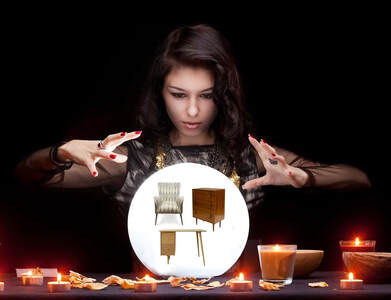 What's In Your Future? What's In Your Future? Florida - Last year we asked five experts from a number of fields related to the decorative arts to try their hand at predicting possible antique and vintage trends for the upcoming year. Their choices were wide-ranging, covering current industry favorites to more obscure selections that were definitely on the genre and niche specific side. The impetus behind the crystal-ball-baiting was to simply see if there was any real correlation between our experts "future" forecasts and the reality of today's marketplace. Oddly enough, it turns out that some of our brave prognosticators might indeed have what it takes to be a full-time seer in their future. To help make sense of all this apparent supernatural insight and the latest decorative arts trends for 2020, we decided to check back-in with a few of last year's top designers and industry tastemakers for some future guidance, and a little past reckoning. Here's what we found. 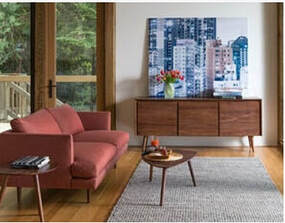 1. Standout With Softer Wood (2019 Prediction) The pendulum is once again swinging from the completely austere 1950s era cabinets with metal accents and vivid coloring, back to a more simple line with the use of natural wood and patina. The statement is far more reflective and subdued than in years past, with an emphasis on the natural grains showing through and softer corners on many of the cabinets and tables. Lower-contrast patterns and a mixing of like materials and scale is becoming more popular than ever. - V. Candice, Interior Designer (2020 Assessment) When we heard this prediction last year, it seemed a bit far-fetched, but true to form, our intrepid interior designer from London seems to have been spot-on, as less modern is now clearly more, and apparently increasing in popularity, as the decorative metal lines of some MCM styles have definitely started to give way to a softer woodier tone. 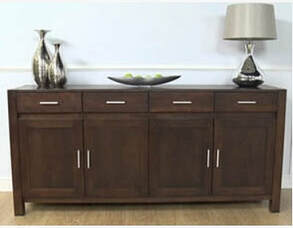 2. Oxidized Dark Oak (2019 Prediction) While we all know of the Golden Oak period from the Victorian era, the newest take on that trend appears to be the oxidization of such wood into a washed-out black. "Out with the old, in with the oxidized oak," seems to be the saying for 2019, at least according to style-influencer and designer Amanda Brown. Simple pieces washed dark, from the thirties and forties, with kitchen-style pulls to add to the modern flair are a great fit for almost any décor. Plus, there's a great selection of these types of cabinets at most second hand and vintage stores - perfect for an inexpensive wash. - A. Brown, Blogger/Influencer/Antique Interior Designer (2020 Assessment) There were some aspects of this prediction that seemed to hold true, but it wasn't' necessarily the color, claims Brown, who says that while painted furniture sales continue to remain strong with many of her suppliers and clients, she does note that black was not necessarily the color of choice. "Yes, lightly colored chalk paints are still raging at the moment, but give it time," she says. "We're already seeing an uptick to the darker side this year." 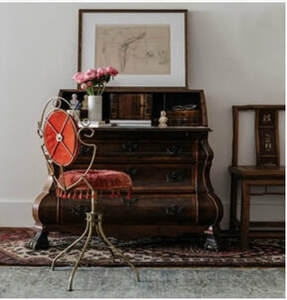 3. Steampunk Infused Design (2019 Prediction) There seems to be no end in sight to the inferential movement towards a neo-Victorian rebirth, based largely on the growth of Steampunk, as not only a wearable fashion, but as a design concept too. Married pieces from the Victorian era with lush colored upholstery and hand wrought metal are especially sought after, and are in high demand with many top designers. The desire for a return to handcrafted authenticity, especially when it comes to furniture and the decorative arts, versus buying mass produced items (including even those made during the mid-century period), will continue to be popular in 2019, and likely beyond. - J. Garner, Private-Picker Extraordinaire/Style Influencer/Writer (2020 Assessment) Technically, this may have been one of the easiest predictions for 2019, as sales of hybrid Victorian pieces with that augmented industrial feel have soared in recent years. But is it just a fad? Not according to Garner who says that the number one request he still receives from customers is for Steampunk. "I'll pick for clients from New York to LA," says Garner, "But invaribly the biggest bump I've seen in demand has been for funky-styled Steampunk pieces." 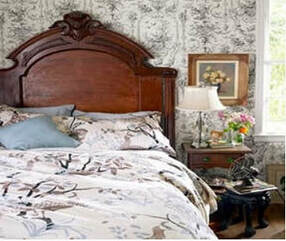 4. Traditional Bedrooms (2019 Prediction) For some antique dealers this might be the sign they've been waiting for... "Cozy warm bedrooms are making a return, says Jan Moyer from an upscale design firm on Manhattan's upper east side. "Bedrooms are definitely getting the warm-wood makeover from years past - we're having trouble just finding enough antique beds and accompanying suites to fill the needs of our clients." Moyer thinks that a return from the stark and linear designs of the 50s is likely to start in the bedroom, since it's where most people want to feel cozy and protected from the world outside. - J. Moyer, interior design firm (2020 Assessment) Design firms can often be on the cutting edge when it comes to breaking trends with so many 'in-the-know' types mingling and working together. But that might not be the case here, as Jackie Moyer pointed out when asked about last year's prognostication for bedroom themes. "It started strong," said Moyer, "but requests for brown fell a bit flat towards the end of the year." However, on a brighter note, Moyer did concede that requests for darker furniture outside the bedroom were up substantially, and have been that way even into 2020.  5. 70's Style Returns (2019 Prediction) And finally, for those of you that have been collecting and buying mid-century like madmen from the 60s, Geena Cole, a style influencer on multiple social media platforms says it might be time to drop everything, hit up your platform shoes, and head for the thrift store for anything rounded and 70-ish. "I see so many of my followers accounts just bursting at the seams with seventies design and fashion," says Cole. This will definitely be the year to get ahead of the crowd and start buying up that curvy design aesthetic - especially the 1970s-inspired rounded furniture which has become the poster child for items from this period. - G. Cole, style influencer (2020 Assessment) There isn't going to be much argument here. Even the school's own surveys and polls tend to corroborate Ms. Cole's contention from last year, but just to be doubly sure, we decided to check back-in with her to see if that 2019 vision was still on the same trajectory for 2020, and it was. "The only difference I've noticed," said Cole, "is the volume of collectors soaking into this market... It's probably double what it was last year, and that's being conservative!" Despite some of the near misses and hits from last year's decorative arts fortune-tellers, it's important to realize that trends are just that... trends. They're bound to change, morph and become something else later on down the road. The key to helping dealers and collectors interpret and act upon such trends within the antiques and vintage marketplace, is by collectively listening to and digesting as many expert industry opinions as possible. They may not always be entirely correct, but when considered in their totality, they can usually point you in a direction that's more often right than it is wrong. - AIA Staff Writers NOTE: For readers seeking more information about the Asheford Institute Of Antiques distance-learning program on professional-level appraising, the study of antiques, collectibles, vintage and mid-century modern items, please click here to visit the school's Home Page.
Should you have additional questions about the Asheford program, you can also write to the school at: [email protected] or call the Registrar's Office toll-free at: 1-877-444-4508. 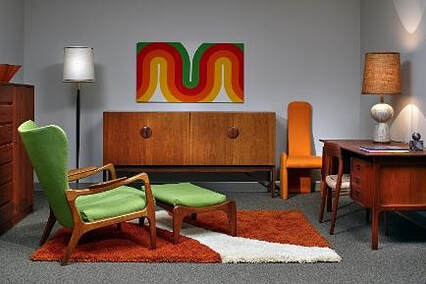 Where Will 'Tomorrow's" Styles Come From? Where Will 'Tomorrow's" Styles Come From? Florida - One of the most satisfying feelings for writers of any genre is to see the continued build-up of organic interest in a story that was published some time ago. Last year, staff writer's here at the Institute showcased an article that dealt with the lack of new decorative arts motifs being developed and created by today's generation of designers. It focused on the noticeably absent themes of original design concepts within the current decorative arts landscape, and tasked a number of experts from this field with explaining the 'how's' and 'whys' of this apparent diminution of fresh new styles and trends. Since the original publication date of this article last February, the school has received an enormous and overwhelming response rate of replies and interest from not only students and graduates, but from those working in the decorative arts community as well. To that end, and as a result of the continued interest being generated by this subject matter, we've decided to repost an "extended" version of this article for not only our current subscribers, but also for our newest readers who may have missed it's original debut last winter. For those who wish to add their voice to this discussion, you can do so on the school's Facebook page at: https://www.facebook.com/ashefordinstitute 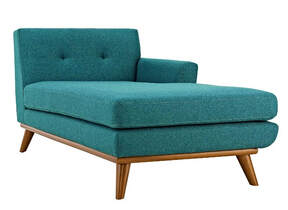 "New" Mid-Century Modern Chaise Being Offered On Wayfair and Amazon "New" Mid-Century Modern Chaise Being Offered On Wayfair and Amazon Current Decorative Arts Trends Lacking Originality... *This is an "extended" article repost from February 2019 Florida - For many years now, antique dealers and vintage sellers have watched in amazement (and to a certain degree, dismay), as the styles and tastes of the buying public have seemingly turned on a dime. What were once stalwarts of the antique industry; Victorian, rustic, early American, and silver, have all given way to more futuristic constructs, from mid-century modern to the more recent vintage and retro infused themes of the 60s, 70s, and 80s. And yet, while many of these recent trends have sailed past the popularity barriers of niche collectors, and into the mainstream markets of such giants as Wayfair and Amazon, it is these old flavors from yesteryear that are now raising an eyebrow amongst some of the country's top decorative arts specialists - many who worry about the lack of new and original styles being created today, for the potential collectors of tomorrow. Or, as Terrence Henessy, a young furniture designer from Los Angeles put it, "Are we creating any new trends for our own generation, or are we simply rehashing familiar designs from the past?" For many, cultural motifs of the time such as post-war modernism and space-age futurism were once the impetus for change within popular styles of the decorative arts, but today there's a feeling we're simply recycling old ideas - while adding only marginally new twists onto variations of a theme, says Rocko Jacques, an interior designer from London who works both sides of the pond. "We copy the mid-century motif instead of creating a new one." Retailers such as Wayfair are not mirroring fresh new ideas and designs reflected in the social and technological advancements of the day, but instead are simply copying and producing what's popular with those in the vintage and retro marketplace. According to Jacques, websites such as Etsy, along with millions of other entrepreneurs selling their vintage wares online, have become the barometer for what's trending, "They're not just reflecting popular tastes and style, in so much as they're creating them," said Jacques. "This is where the new design trends are coming from - they're not really original - but rather just recast from years gone by." Henessy, who echo's many of Jacques thoughts, also noted that while some of the pieces in his LA design shop utilized the curvy plastic look from the seventies, he tries to keep the "borrowing" to a minimum. "The decorative arts style of the early 70s with it's modular design, egg-shaped chairs, and heavy use of wrap-around white plastic was completely new and based on the futuristic themes inspired by the space race," says Henessy, "To copy it too completely is not paying homage to those great original designers, but instead is really just ripping them off." 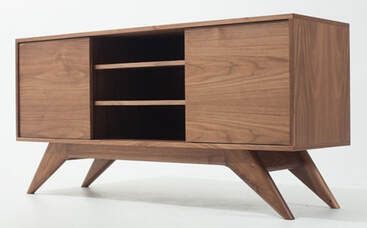 Handcrafted Mid-Century Modern "Inspired" Credenza Handcrafted Mid-Century Modern "Inspired" Credenza Patrick Davis, another west coast designer and furniture craftsman thinks that it's almost a self-fulfilling prophecy when it comes to older styles repeating themselves. "Once the ball started rolling on Mid-century, it was hard to stop - I went from restoring 50's pieces to creating them because the demand was so high." Davis acknowledges that his real goal was always to develop new styles and types of furniture, but when MCM came along, he says it just kind of sucked out the creative juices because he couldn't justify original experimentation over the profitability of making "new" mid-century pieces. For some, the trend-setting variance is simply a matter of degree. Where designers once took their cues from large changes in the social and political movements of a time, such as the space race, it seems that today we're left with a far different landscape. iPhones and the like can have an effect, but it's not as transformative in the way it once was. IBM gave way to the notion of real computers in the 1960's, and the public's imagination soon followed - all the way to the silver screen - with films like Space Odyssey 2001 and the nefarious HAL computer, which not only inspired a generation of tech geeks (think Bill Gates), but trickled down to fashion and décor with uniform style pant-suits, and modular spaceship furniture. The seventies became a generation inspired by its own time - not the other way round. For many in the decorative arts field, there's a strong sense of optimism that something fresh and new might be looming just over the horizon - a renaissance of spirit and original design. Whether this generation can salvage its own unique and iconic trend-setting style remains to be seen. "I wouldn't necessarily bet against it," said Jacques. However, when presented with a recent article from a top design school that showed seven out of ten students chose mid-century modern as the most influential trend of the time, Jacques responded, "Well, I guess we've got a way to go then..." - AIA Staff Writers NOTE: For readers seeking more information about the Asheford Institute Of Antiques distance-learning program on professional-level appraising, the study of antiques, collectibles, vintage and mid-century modern items, please click here to visit the school's Home Page.
Should you have additional questions about the Asheford program, you can also write to the school at: [email protected] or call the Registrar's Office toll-free at: 1-877-444-4508.  Florida - The Asheford Institute's latest results from its yearly annual survey of top buying trends within the antiques, vintage and collectibles marketplace was just released by the school this past week. The Institute, which has been conducting the industry related survey on its graduates for over eleven years now, uploaded its latest trending data on decorative arts sales for 2019, via a dedicated page on the school's web site. Continuing with the theme from last year's survey, was a new questionnaire format which focused on compiling and grouping information related to customers decorative arts buying habits over a twelve month period. Strong interest from past readers looking for updates to previous years polling statistics prompted the change in format construction of the survey in 2018, and again in 2019, to include even more detailed information regarding the popularity of specific buying genres within the antiques and vintage marketplace. "We're continuing to ask questions that further redefine the best sales categories and practices for both antique and vintage dealers alike," said current director of the Institute, Charles Green. "This involves providing our readers with as much relevant information as possible about the state of today's decorative arts marketplace, as well as being able to show them what's actually selling in their geographic region." According to Green, the number of poll respondents queried in the survey has also jumped year-over-year. "In 2018 we increased the survey size by fifteen-percent, and this past year we've upped that number again by another ten-percent." The school's director believes the increase in respondents has led to a more accurate representation of data sampling regarding the popularity of particular sales categories within the antiques and collectibles marketplace. "The bigger numbers are simply giving us a more comprehensive picture of sales results," said Green. As the school's lead researcher for the survey, Anthony Harper, agrees with much of the director's comments about the revised poll format, while reiterating that the main crux of the Institute's survey has always been to provide as precise an analysis as possible of measurable interest in current decorative arts trends. Harper went on to state that the key to getting meaningful survey results was based on receiving actual sales data alongside item-specific requests from buyers. Harper, who has been instrumental in the development of the school's surveys for over a decade now, says he's still amazed at how well the results of past polls have managed to stand the test of time. "When we first started out, we weren't sure if we were reflecting actual overall market conditions, or just a niche representation." However, since those first days, Harper said that not only did the poll results reveal where the market was at, but more importantly, it often foreshadowed where it was going to be. "That was probably the most valuable piece of data we could have hoped for," says Harper. 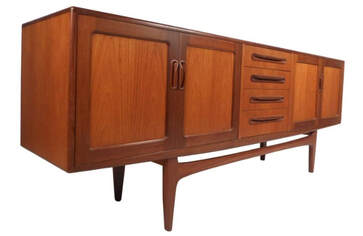 While Still Popular MCM Facing Some Competition While Still Popular MCM Facing Some Competition While members of the school's research staff stress that the current survey being conducted is still based on a series of general questions, and non standardized statistical formulas, the results are nevertheless compelling when looked at in their entirety. “Sometimes when a trend gets going it's hard to stop," said Amber Shole, a research assistant on the school's polling team, "but this year that's exactly what happened." Shole says that a certain historical event surprised many industry insiders by skewing the statistics somewhat about half-way through the year. "It was a bit of an outlier, so that was the shock, but once it picked up steam, it just kept on rolling," said Shole. Of course there are always going to be a few perennial poll favorites, like Mid-Century Modern and Automobilia, but Shole notes that changes are continuing to brew. "There's definitely a sense that we're starting to turn the corner from the full-on modern motif towards something a little more subtle and subdued." And, while she admits that items from the mid to latter-half of the twentieth-century continue to be hot, she says that older more established areas of collecting are beginning to gain back some ground. "Thrifters, and pickers are starting to look at Victorian items, and we're also beginning to see a real uptick in the demand for more formal pieces from the Georgian period as well." Shole says that if anything, 2019's poll clearly demonstrates that there's a new breed of buyer who's willing to step beyond the traditional collecting boundaries that have been a staple of the industry for the last twenty years. "Whether or not this amounts to a tsunami of change or a trickle, remains to be seen," says Shole, "but either way, it's a nice starting point for some old favorites..." For readers seeking the full results of the school's current 2019 decorative arts survey/poll (including this years outlier), you'll find it, and more online at: https://www.asheford.com/2019-survey-results.html NOTE: For readers seeking more information about the Asheford Institute Of Antiques distance-learning program on professional-level appraising, the study of antiques, collectibles, vintage and mid-century modern items, please click here to visit the school's Home Page. Should you have additional questions about the Asheford program, you can also write to the school at: [email protected] or call the Registrar's Office toll-free at: 1-877-444-4508.
 Pennsylvania - Just like the popular PBS television series, This Old House, it would seem that people, no matter what the subject, will always have questions surrounding the topic of things that are old - whether it's a house, piece of furniture or even a doll. However, when it comes to collectible dolls, this statement is usually followed up with the classic value refrain of, "I have an old doll... BUT, can you also tell me what it's worth?" As a doll collector, appraiser, and restorer, questions of age and value are usually the most common queries to hit my inbox on a daily basis. While there's often no simple textbook answer to most of these questions, there are a few important consideration points I like to suggest to individuals before proceeding with any kind of response. Often, when prospective clients reach out to me with statements regarding age and value, terminology clarification is usually required. For example, the term old has several meanings, which may or may not be what a client has in mind when first positing a question. Old, as defined by Merriam-Webster is something dating from the remote past (ancient), or persisting from an earlier time. However, old is also defined as having existed for a specified period of time; of, relating to, or originating in a past era; being advanced in years or age. Once I'm able to convey the range of possibilities that can come with the use of such terms, I'm often in a much better position to be able to formulate a clearer and more precise response to clients initial queries, since we're now sharing a mutual understanding of the terminology being used, as well as any implied meanings that may exist outside the scope of traditional definitions. In the world of doll collecting, there are several 'age' categories to consider. These include: antique, vintage, contemporary and modern. Understanding the differences and nuances between these categories can often be confusing to individuals and even some novice collectors, as many simply lump the entirety into the classification of old. Determining what separates these categories is key when it comes to understanding the concept of value and worth. Antique dolls are those that existed prior to a hundred years from today's date (i.e. a doll produced before 1919). Dolls from this period were most often made of bisque or biscuit porcelain. These dolls would often have bodies made from materials such as kid or unbleached muslin filled with sawdust or horsehair, or bodies whittled from wood, pressed wood composite, or celluloid (Note: celluloid nitrate, alcohol, camphor pigments, and similar fillers are materials manufacturers would not use today). Other materials that were used for bodies during this period included wax over bisque, wax over papier mache, and even corncobs. Vintage dolls are those which were created within the last seventy-five to ninety-nine years. Most of the bodies were made of similar materials as those used in antique dolls, with a few notable differences. Substances that are akin to vintage and modern dolls would include such materials as, hard plastics, vinyl, and magic skin (latex/vinyl with the texture of a balloon stuffed with a padding fabric).  Pedigree, England. Circa, 1950 Pedigree, England. Circa, 1950 In truth, most individuals who come to me with a question of worth and value, usually have the latter category of doll in hand when arriving for an assessment (and that's usually what I end up telling them), especially after we've finished having the "what is old" discussion. It may not always be what they want to hear, but nine times out of ten, it's usually the case. So in the end, what is it that really determines a dolls worth and value? As with most other things in the decorative arts market, it comes down to a few simple factors - just as most antique and vintage items are based on rarity, condition, manufacturer, and current popularity with regard to sales - so are dolls. However, with that being said, dolls can sometimes fall outside the purview of mainstream evaluation techniques when buyers and sellers both have a vested sentimental interest in the item being offered up for sale. While this condition usually forces up the selling price, and can also exist in traditional antique sales, my experience has shown it to be far more prevalent when it comes to dolls exchanging hands.  Valarie Moyer AIA, PACC, is an Asheford honors graduate, an alumni of Columbia Southern University, and a passionate writer and preservationist of antique and vintage dolls. When not working as an author, speaker and member of the United Federation of Doll Clubs, you'll often find her tending to her clients at Unique Dolls & Gifts Doll Hospital in Jonestown, Pennsylvania NOTE: For readers seeking more information about the Asheford Institute Of Antiques distance-learning program on professional-level appraising, the study of antiques, collectibles, vintage and mid-century modern items, please click here to visit the school's Home Page.
Should you have additional questions about the Asheford program, you can also write to the school at: [email protected] or call the Registrar's Office toll-free at: 1-877-444-4508 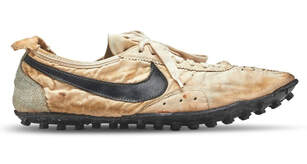 1972 Nike Track Shoe Sells For Just Under $500,000 1972 Nike Track Shoe Sells For Just Under $500,000 Florida - It's not everyday that one thinks of a ratty old pair of track sneakers as being worth as much as a house, but that's exactly what happened at a Sotheby's auction in New York recently. Falling just under the hammer near $500,000, a pair of (used) Nike track shoes designed by company co-founder Bill Bowerman, set a whopping new record for everyday footwear to be sold at a public auction. While there was obviously some "fiscal" provenance attached to the sale, as the shoes were associated with Mr. Bowerman, industry insiders were nevertheless stunned by the massive amount paid by a collector in Canada, who planned on displaying the shoes in his car museum outside of Toronto. Less than four years prior, an almost identical pair of the waffle-iron sneakers sold on eBay for just over $11,000, which at the time also came as a shock to many textile collectors. However, moving from eBay into the big leagues of Sotheby's in such a short a period of time is a clear indicator of just how popular this form of vintage collectible has become. Twenty-four year old Matt Dixon, a young antique dealer in England, who's been collecting for years wasn't that surprised when he heard the news. "Anything with a big name, a designer name, anything that's got any real heritage and credentials is always going to be sought after because it'll always have value." While this sentiment is often true of most top quality antique and vintage items, it's rarely been applied to everyday footwear in the same manner. Matt says he thinks of sneakers as an investment, just like all his other antiques. "Buying things like these trainers, there's no doubt they will go up in value again in another 10-15 years' time when they come back on sale." For older dealers, the new footwear trend (and prices) can be hard to fathom at times. Gordon White, a long-time textile dealer and picker from New York, says he heard about the trend from his son a couple years ago, when he traded a pair of old Converse basketball shoes for a hundred-dollar gift card to a colleague at a restaurant where they both worked. "I was simply flabbergasted," said White, "They didn't even have laces in them!" Since that time White says he's gone on to collecting vintage footwear full-time. "I've added this to my storefront display in a big way," says White, who concedes that his son's good business sense has been responsible for a huge uptick in the stores' overall sales. "Never in my wildest dreams would I have imagined that something so smelly and dirty could be worth so much, but I guess that just proves that old dogs can still be taught a trick or two." 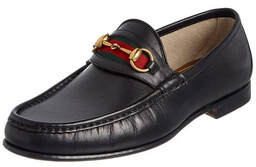 Gucci Thrift Find For $9, Sold For $100 Gucci Thrift Find For $9, Sold For $100 Robert Franks, one of the founders of Kick Game, a British company that specializes in rare and vintage footwear, says he thinks that most people simply aren't aware of how big the market really is for this kind of enterprise. "The secondary selling industry for trainers is massive - it's like watches and wine - and is the largest unregulated market in the world." Franks says that when a well-known company releases a limited-edition shoe, they'll often try to buy the entire lot in anticipation of strong short-term and long-term appreciation. "It's just gone berserk in the last few years. People end up camping outside shops just to get their hands on these shoes because they know as soon as they walk out of the shop with them, they are worth potentially three or four times the original price." For others in the antique and vintage industry, coming on board with the new footwear revolution has taken some time. "I bought two pairs of loafers for my husband who didn't like them," says Jessica Alford, a regular on Etsy who shops almost exclusively in textiles, "but when I examined them closely, they turned out to be rare Gucci's, which I later sold for ten times what I'd paid." Alford admits she doesn't always win on the deal, but that she's getting much better at spying what will sell and what won't. For those dealers still contemplating whether or not to jump into the burgeoning vintage and collectible shoe market, Noah Wunsch, Sotheby’s Global Head of eCommerce, probably summed it up best when asked about the auction houses' premiere sneaker sale, "This was our first trainer auction, and the incredible results are a sure sign that the market is growing, and that collectors are taking notice of trainers as objects of design. It's worthwhile checking to see if you've got any rare pairs stashed away." That's certainly some sage advice for us here at the Institute also, as we're pretty sure there are likely to be more than a few people around the world sitting on a small fortune in a shoe-box tucked away in the back of their closet. - AIA Staff Writers  NOTE: For readers seeking more information about the Asheford Institute Of Antiques distance-learning program on professional-level appraising, the study of antiques, collectibles, vintage and mid-century modern items, please click here to visit the school's Home Page.
Should you have additional questions about the Asheford program, you can also write to the school at: [email protected] or call the Registrar's Office toll-free at: 1-877-444-4508  Toronto - For antique and vintage dealers, auction sales can be a great way to build up stock. Whether you prefer the rush of the traditional live auction or buying online from home, there’s a sale to suit everyone. Whatever the environment, auctions are exciting and fast moving, while for some, the idea of bidding at auctions can even be a tad intimidating. But the method, whether live or online, follows the same general principles, and once you get to know the basics, you’ll realize that it’s a straightforward and profitable way of buying and selling goods. For those looking to get into the world of auction buying, here are some tips to make the auction experience a rewarding one. Get to Know the Auctioneers To start, get to know auctioneers in your area. Attend a few in person or log on during an online auction to see how things are done. Buying and selling processes can vary across auction houses, so it’s important to get to know how different companies work. Know What You’re Buying Once you’ve sourced a good auction and registered to bid, it’s a good idea to attend the preview or examine the online catalogue ahead of time. This will give you an opportunity to do a bit of research and assess the value of the items before bidding starts. If you’re unable to attend a live auction, there may be an opportunity to leave an absentee bid. Online auctions offer an opportunity to place max bids ahead of time as well. Set Your Limits It’s easy to get caught up in the excitement of the auction process. Setting a limit ahead of time, and sticking to it will guarantee you don’t spend more than you can afford. Once the live bidding starts, things move quickly, so it’s important to follow along and listen carefully. The traditional process is for the auctioneer to call out the lot number and a brief description of the item and the opening bid amount. Once that amount is met, the price increments move up until the bidding stops and the item is sold to the highest bidder. In online auctions, however, there is often a ‘soft close’ on lots. As an item is coming to a close and there is a last minute bid, a few more minutes will be added to the clock to allow for more bids. Watch For Other Dealers Research is great, but sometimes you might not be able to find the answer you're looking for even online. However, if you think you've found something of value, but are unsure as to what to bid, look around for other individuals who appear to be interested in similar items as yourself. If it's the same small group popping up their auction paddles whenever you do, chances are you've found the dealers. Contrary to popular belief, most antique dealers welcome interaction with other dealers, and will often work with them to help identify items and share knowledge. While encouraging other dealers to refrain from bidding on an item is not allowed, and may be seen as collusion, expressing your particular interest in an item is not. Research Payment Terms Get to know the payment terms. Is there a buyer’s premium (auction house’s fee)? Are there reserve prices placed on items (the minimum price the seller is willing to accept)? It’s important to factor in all of these costs including any additional costs for repairs, transportation, and even your time. Pick-Up & Delivery Make sure to check pick-up details for online auctions. Often items need to be picked up during a short window of time on a particular day. Some places may ship items, but this would be another cost to be factored into your overall budget. If you're planning on buying larger items, make sure they can fit into your vehicle. If not, consider renting a small trailer (if you have a hitch), or a moving van. But remember, you'll need to factor in these costs as a portion of your overall auction spend. By simply adding these few simple tips to your outing, it's likely you'll have a more positive and profitable auction experience.  Martha Norton, AIA, PACC, is an honors Asheford graduate, decorative arts freelance writer, and a curator/dealer of fine antique and vintage pieces in Waterloo, Ontario, who can be found tending to her space at Mercury Antique and Vintage most days NOTE: For readers seeking more information about the Asheford Institute Of Antiques distance-learning program on professional-level appraising, the study of antiques, collectibles, vintage and mid-century modern items, please click here to visit the school's Home Page.
Should you have additional questions about the Asheford program, you can also write to the school at: [email protected] or call the Registrar's Office toll-free at: 1-877-444-4508  Florida - For some, blending may be the new curated, but for many it's likely to be just another term being thrown into the confusing mix of choices when it comes to operating an antiques and decorative arts business. Over the past twenty years, many dealers in antiques have morphed their operations and storefronts from traditional wares and locations into online venues and mid-century themes. However, as we wrote about last month, these lines are now beginning to blur as some of the more common modernist motifs are beginning to recede in favor of a more 'antiquated' look. In our second-part of this series, we're examining the role "vintage" items are now playing when it comes to some antique dealers stock and how it's affecting their bottom line. From the very beginning of the slide in traditional antiques, back in the early nineteen-nineties, it was clear to many in the industry that something would eventually need to replace it. Both New York and London were at the epicenter of the shift as top dealers dropped in numbers by over 70%, according to Clinton Howell, a New York-based dealer in English furniture and the president of CINOA and the Art & Antiques Dealers League. However, by the turn of the new millennium, younger entrants into the decorative arts market saw the interest in early modernist themes and began popping up storefronts in hip and upcoming spaces - often in underdeveloped and underappreciated urban neighborhoods. Not to be outdone, older more established antique dealers started to notice the trend, and soon began to follow the pattern by hunting for the odd and unusual top-of-the-line mid-century piece to add to their own inventory. As the mid-century movement took off, so did sales for those who had adapted to the new trend. However, for those dealers who didn't fully embrace the modernist attitude, a new and less expensive theme began to emerge; vintage. While initially used as a catchphrase to encompass everything that wasn't antique, the term eventually began to take on a life of its own, often representing decade specific pieces that were usually emblematic of a particular time and style. Antique dealers who latched onto the burgeoning trend were often handsomely rewarded for their foresight. 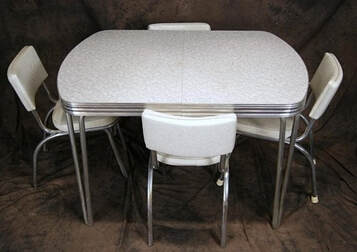 "Arborite blended well," Said Avery "Arborite blended well," Said Avery Jason Avery, an antiques dealer from San Diego, is unapologetic about blending his inventories. When he started his business in the late 1990's, he was selling primarily Mission furniture, but quickly realized the trend seemed to have worn-out its welcome, and began hunting for kitschy stuff that was inexpensive, but resonated with a younger crowd. "I noticed some Arborite tables at a garage sale," said Avery. "I brought them home, thought they looked good with our darker wood pieces, and managed to sell both." Avery describes those first blended sales of vintage and antique wood pieces like a light going off. "It just worked," he said. "I've been adding vintage themed stuff to our overall inventory ever since. People really seem to like the contrast, and will often buy an antique piece as an accompaniment to their vintage purchase just because they like how they look together." For others like Sherry and Nick Wilson who run an antique and vintage co-op in Idaho, blending was the key to their success. When they took over the old "antique mall" in Sherry's hometown, dealers were struggling with late Victorian items and country themed furniture from the nineteen-thirties. "It wasn't all bad," says Sherry, who had previously worked in a 'cool' consignment shop in Chicago, "its just that it needed some updating and rebranding." With the help of her husband, they were able to convince most of the vendors to start upcycling vintage and retro finds into their existing inventory. "We told them to use the wood pieces to showcase some of the vintage items," says Nick, "and it worked - they started selling not only the newer stuff but also some of the older inventory that had been sitting for months." Both the Wilson's caution that this approach may not work for everyone, as Sherry points to the fact that her previous place of employment in Chicago was strictly mid-century themed, which she initially tried to bring to the co-op. "It just didn't work," said Sherry, "We tried, but folks weren't willing to pay the high prices for the latest trend, so we moved to vintage and retro and have never looked back." For many other dealers in the market it would seem that the run to blend more vintage and retro items into one's inventory may now be the new normal, or as one sartorially inclined dealer put it, "It's now become the antique dealer's new black."  J. Hobson (AIA), is a former honors graduate of the Asheford Institute and a freelance writer who specializes in business trends in today's antique and vintage marketplaces. She comes by her experience honestly, having operated one of the southeasts largest antique malls for over ten years before moving onto her own business in San Antonio's upscale La Cantera district. 
NOTE: For readers seeking more information about the Asheford Institute Of Antiques distance-learning program on professional-level appraising, the study of antiques, collectibles, vintage and mid-century modern items, please click here to visit the school's Home Page. Should you have additional questions about the Asheford program, you can also write to the school at: [email protected] or call the Registrar's Office toll-free at: 1-877-444- 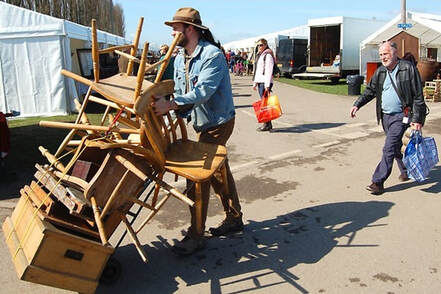 Following The Latest trends? Following The Latest trends? Florida - It's often been said that "Success is the ability to adapt to change," and while this statement is probably as ancient as the wind itself, it's likely to resonate more strongly today for those in the decorative arts business than it ever has before. As antique dealers and vintage store owners combine and begin morphing into one, it's become not only an age-old mantra with currency for the modern world, but a necessary mindset for those hoping to succeed in this rapidly evolving industry. Less than twenty-five years ago, the role of the traditional antiques dealer appeared to be set in stone. Antiques were antiques, and everything else was simply collectibles, memorabilia, or used furniture. Then, in what seemed like an overnight glacial-shift of decorative arts interests, traditional antiques fell out of favor, and everything else suddenly became vintage, retro, and popular. Since that time, there has been a softening and blurring of the lines, as some antiques have bounced back, and some vintage items have been upcycled and recreated to more closely emulate their older cousins. The Steampunk and Industrial look came about as a neo-Victorian revival against much of the mid-century-modern motifs from the first part of the century. However, it's only recently that the phenomena of a full-scale reactionary change to the overall modernist look has begun to take place within the decorative arts community as a whole. For many in the industry, it was simply a creeper effect more than anything else, says Carey Doleman, an interior designer and vintage store owner from Miami's South Beach area. "We've always been big on vibrant colors here, but a lot of clients have been coming in recently looking for more earthy and woodsy tones in their furniture." Doleman says that prior to this people wanted chalk paints and vintage furniture completely upcycled into dramatic color schemes that removed any traces of the wood. Today however, she's finding that many are now leaving the tops of tables in their original state, and only painting the legs. "There's no question," says Doleman, "we've changed some of our inventory back to reflect more naturally exposed wood, because that's what customers are requesting." 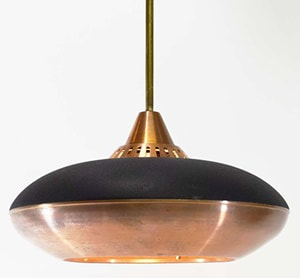 Copper Lighting From 80s Becoming Popular Copper Lighting From 80s Becoming Popular For Kimberly Nash, an antiques and vintage lighting specialist from Rhode Island, the move away from the modernist themes of the century's early years were more pronounced. "For the longest time any mid-century or stainless themed object we had would sell almost instantly, but recently we've seen some of that inventory backing up." Nash says that her partner, while out on a buying trip last summer, snagged some older industrial copper lighting from the early 1980's, and literally had it sold before it hit the showroom floor. "I was astonished," said Nash, "So we started looking for more, and since then, have unloaded every piece to either interior decorators, or upscale home-design centers in the city."  Treasure Fest In San Francisco Treasure Fest In San Francisco Artisan markets, a new type of upscale venue that often showcases combined antique and vintage resellers as a single entity, are also apparently seeing a shift back towards more traditional decorative arts styles. Henry Carlson, an antiques dealer from the west coast, often frequents Treasure Fest, an artisan market in the San Francisco Bay Area, and says that he's noticed a lot of the hip and up-and-coming dealers who show at the market are definitely incorporating a lot more natural wood and patina than ever before. "I come here often just to see what the youngsters are showing, because inevitably in the next few years, I'll probably be trying some of it on for size as well," he commented. While Carlson admits that not everything at the show will likely move to the mainstream, he notes that their recent track-record for the most part has been pretty good at predicting major changes in tastes and styles related to the decorative arts. "As a dealer you can't follow every single trend, but getting some guidance on where the bigger movements might be heading sure can be of help." On the flip side of the coin, some of these same fresh-faced vintage dealers who haunt artisan markets like Treasure Fest, are experiencing trend changes for the first time in their professional lives. Colin Hackett, who's been renting booths at vintage shows and fairs for over ten years, admits it's going to be a tough slog if he has to start learning about traditional antiques. "When I came on board everything was vintage and retro, and you just kind of learnt as you went along, but antiques have a history and culture around them, so it's going to take time and study if I want to successfully incorporate them into my inventory." For a number of the younger dealers, the idea that trends can change is something entirely new. While for veterans of the trade, it can often seem like an imperceptible shift where one's timing has to be just right. Wait too long and the party's almost over. Jump in too early and you may end up with inventory that's not quite ready for primetime yet. Or, as South Beach dealer Carey Dolman described to her vintage colleagues over brunch one Sunday morning, "It's kind of like picking fruit from the buffet table... getting the ripe pieces can take some practice." - A.I.A. Staff Writer's NOTE: For readers seeking more information about the Asheford Institute Of Antiques distance-learning program on professional-level appraising, the study of antiques, collectibles, vintage and mid-century modern items, please click here to visit the school's Home Page.
Should you have additional questions about the Asheford program, you can also write to the school at: [email protected] or call the Registrar's Office toll-free at: 1-877-444-4508  Stylized Surfing Posters Are Popular Picks Stylized Surfing Posters Are Popular Picks Florida - With summer in full swing, we thought it might be the perfect time to look at one of the hottest collecting commodities in today's vintage and antique marketplaces. For years now, astute dealers and buyers have been quietly snapping-up what many consider to be one of the best untapped areas for collecting within the decorative arts field. Surfing, its related forms, and wide array of potential memorabilia, has finally arrived. No longer just the domain of "dudes" and "dudettes" living along coastlines, the surfing phenomena has come to the masses. Whereas surf-themed dealers once relied upon a niche market of geographically similar clients to support their wares, the popularity of the sport and associated accoutrements, has now spread firmly across the globe... and inland. Car commercials hawking Lincoln and cool-cat Matthew McConaughey as he heads for a "sesh," or Canadian potato-chip manufacturer Hardbite, showing surf-dogs on their chip-bags, are all part of the surfing allure and its new mainstream embrace. Films such as Mavericks, and Blue Crush have also helped to catapult the lifestyle sport to an even higher level with a younger generation, while pro surfers such as Laird Hamilton and Kelly Slater have helped push the "cool" factor into the stratosphere.  Even Potato Chip Companies Are Cashing In Even Potato Chip Companies Are Cashing In For dealers who got in early on the move towards mainstream merchandizing, surfing memorabilia has skyrocketed in value. Tommy Shantz a part-time picker (and surfer) from Santa Cruz, California, says it's all about the pick. "I started suss'ing stuff from local legends back in the 70s and 80s," says Shantz, "I just didn't realize that my signed Greg Noll surfboards would be a hot ticket in Des Moines twenty years later!" Shantz says that while he collects virtually everything related to surfing, some things are just more popular than others. "Boards are all the rage right now, especially Hawaiian woody long-boards from the 20s and 30s, which people are using to decorate their pads with." Shantz recounts that twenty years ago only surfers did up their digs with equipment, but that today he sees boards hanging over dining room tables like expensive chandeliers. It's not just coastal dealers who are experiencing the boom though. Nancy Brown, a vintage seller in a summer resort town from Wisconsin, says that Great Lake surfers have been plying the waters for years in her area and are picking up anything she can find that's related to the history of fresh water surfing. "It's really kind of cool to see what this is all about," said Brown. "I never even realized that you could surf on a lake until recently!" Her latest sale involved a collection of black & white photos she came across at a cottage yard sale on Lake Superior, that showed a group of men surfing in what appeared to be the late 1960's. "You could see the old cars in the foreground, so it helped date the pictures to sometime from that era," she said. A quick scan of eBay and Etsy listings shows just how strong the market has become for surf themed items, from classic beach signs to vintage t-shirts, posters, and even competitor trophies. Maddy Croft, an online retailer on Etsy says she began selling "surf-wares" when her brother started ditching all his old surf clothes. "One day he came home and cleaned out his closet, but before he could pitch them, I tried selling them online," she said, "and by the end of the week they were gone." Croft says items from older surf companies such as Quicksilver and Instinct, that can be shown to be truly vintage, can command high prices. "There's still lots of cheap product in most thrift and second-hand stores says Maddy, you just have to be willing to dig through it." For those hoping to cash in on the recent popularity of the trend, Tommy Shantz says that it's still a great time as there are plenty of pieces out there that can be picked up cheaply. "Obviously coastal communities are going to have more of a selection, but I've picked up some really cool items inland too," said Shantz "...and at great prices." As to how long the trend will last is anybody's guess, but surfing and its accompanying lifestyle has always been the domain of the cool kids, at least according to Maddy Croft. "Local surfers kind of ruled when I was young, and often set the trends, and I think they still do in many respects," said Croft. "So if coolness is a factor in longevity, then I think we'll probably see this trend stick around for quite some time."  C. Clarkson (AIA, AAM), is a former Asheford honors graduate and a New York-based writer/editor who's a self-professed mid-century modern junkie with more than a decade of experience covering the decorative arts scene. Ms. Clarkson also curates two Etsy shops and spends weekends hunting down the treasures with her dog Spike. NOTE: For readers seeking more information about the Asheford Institute Of Antiques distance-learning program on professional-level appraising, the study of antiques, collectibles, vintage and mid-century modern items, please click here to visit the school's Home Page.
Should you have additional questions about the Asheford program, you can also write to the school at: [email protected] or call the Registrar's Office toll-free at: 1-877-444-4508 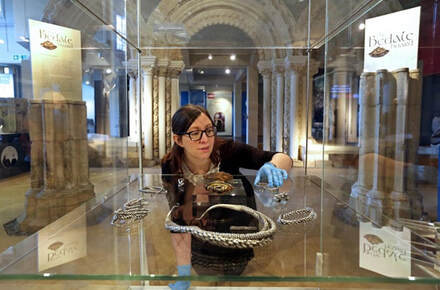 "Curator" Once Denoted Something Far Less Common Than Today "Curator" Once Denoted Something Far Less Common Than Today Florida - It would seem that everyone's a "curator" these days. No longer just the purview and title of those who work for museums and galleries as protectors of cultural heritage - curators can now apparently be found everywhere - from Esty to Goodwill stores, thrift shops, and all points in between. If you've got something used to sell, you'll likely see it being offered up as part of a carefully crafted "curated collection." But how did this fanciful moniker, once reserved for the those in the upper-echelons of the decorative arts and museum staff, become so pervasive in regard to the sale of today's used, vintage, and retro items? For some, the term came about as a matter of economy and distinction, at least according to Tara Johnson, a long-term vintage store operator on Etsy, who thinks that it was simply a way to elevate one's inventory, or one's own professional status, when comparing themselves to other dealers. "We're all selling on the same platform," says Johnson, "So trying to differentiate yourself from the competition can be difficult when the layout of your virtual store is pretty much the same as your neighbor." While Johnson continues to use the term on both her website and Esty shop, she does acknowledge that the descriptor is perhaps getting a little long in the tooth. "I've seen signs at grocery stores where apples are being curated," she said, "that seems a bit ridiculous." For others in the industry, it would appear to be somewhat of a shared sentiment. Allison Tanner, a retired auctioneer and antique store owner, who volunteers part time at a large charity shop in the greater metro Atlanta area, says the whole expression is a bit bewildering. "We just have general goods and chattels coming in mostly," says Tanner, "However, we're told to group items together (in no particular order), and then to sell them as part of a curated collection." Tanner thinks the whole idea is sort of crazy, "I get that you want to increase sales by indicating that you have something special, but hanging a sign over used garden furniture from Walmart that reads, Today's Curated Collection, seems a bit absurd." On the flip side, a number of dealers point to the fact that unlike true antiques, many vintage items can't really stand on their own without a bit of creative curatorship, since they don't have the same kind of history backing them up as more traditional antiques often do. "I suppose it's a bit of literary license and salesmanship all rolled into one," says Doug Plath, a vintage dealer who operates multiple online stores on both Etsy and EBTH (Everything But The House). "What I'm trying to get across with the curated title is that my items are unique and original, even though some of them may have been mass produced." For many, this runs contrary to the antique ethos of rare and unusual. "Antique dealers don't really have to spice things up too much," says Plath, "the pieces often speak for themselves, whereas vintage and retro items can sometimes benefit from a little descriptive bump." While this may be the rule rather than the exception for many vintage dealers now, a number of store owners on Etsy have reportedly decided to take a more light-hearted approach to institutionalized curatorship, by offering a few prize-winning customers a chance to "curate" their stores favorite collections. One venue even went so far as to headline the event as a chance to "Curate the curator..." There is clearly no final answer here as to "curate" or "not to curate" - but one thing is certain - sometimes expression-fatigue can suddenly set in, and when it does, it's often a good indicator that it's time to move on. Whether or not that time has come for this expression remains to be seen, but when a famous university in northern Michigan places curator, curated and 'to curate' on its list of banished words, it might just be worth the effort to start considering an exit-strategy... - A.I.A. Staff Writer's NOTE: For readers seeking more information about the Asheford Institute Of Antiques distance-learning program on professional-level appraising, the study of antiques, collectibles, vintage and mid-century modern items, please click here to visit the school's Home Page.
Should you have additional questions about the Asheford program, you can also write to the school at: [email protected] or call the Registrar's Office toll-free at: 1-877-444-4508  Florida - For sometime now it's been suggested by many in the antiques trade that the business is simply not like it was in years past, when there was a strong interest by the public in almost all things antique. Or, as David Rasuchkolb, an old-school dealer in upstate New York recently put it, "There was once a time when the younger generation led the way in the purchase and sales of antiques, and the rest of us followed - unfortunately that period ended during the early nineteen-nineties." 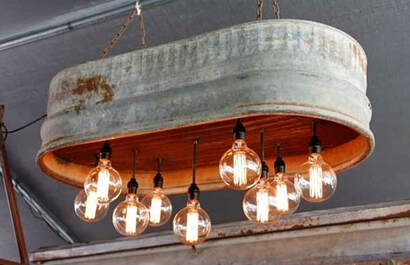 Inexpensive upcycled fusion pieces are popular with millennials Inexpensive upcycled fusion pieces are popular with millennials For many in the industry, the next twenty years seemed to be a case of endlessly wandering the desert in search of the perfect fit for dealer and customer. It was also during this time that the stainless-steel revolution entered the market, and things seemed to fall even further down the rabbit hole, as the public shifted away from anything old, choosing instead to migrate to the land of Ikea and everything that was shiny, new and disposable. Fast-forward a decade or two, and suddenly you have the stirrings of a mass resurgence in interest related to not only antiques but to almost anything old (or used). Enter the millennial, the most unlikely demographic source for the potential resurrection of the traditional antiques market as one could imagine. While this somewhat odd pairing may have seemed unlikely at first to many in the industry, to Tina Wayne, an online retailer with a vintage shop on Etsy and eBay, the connection couldn't have been more obvious. "Millennials want to be cool and standout," she said, "but it's hard to do so when buying the same catalog furniture as everyone else, or being priced out of the mid-century market, so you end up turning to whatever's leftover to make a statement about your individuality." While Wayne's assessment may be somewhat far-reaching in scope, her instincts seem to indicate that she may be onto something, as numerous online shops, as well as bricks & mortar dealers are reporting strong upticks in the sales of items that for some, have been languishing in their back-rooms for years. Timothy Pike, a pop-up dealer who tours the circuit of Southern antique shows and fairs, says he's now carrying all things Victorian again because they're cheap to buy, and cheap to sell. "I've noticed that it's the millennials who are basically trying to design-on-a-dime that are snapping these pieces up," he said. "For them, there's so much variety to Victorian pieces, and none of it really looks exactly the same - unlike their iPhones!" 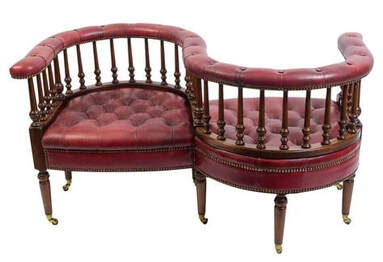 Millennials are quickly snatching up quirky pieces such as this Conversation Settee Millennials are quickly snatching up quirky pieces such as this Conversation Settee Being original is certainly an impetus for millennials as they age, as it's a generation that was often knocked with the moniker of sameness and herd-mentality when it came to expressing their interests in anything - including the decorative arts. However, today that notion seems to be changing rather quickly, as Susan Hoftner, a millennial herself, noted when over on a buying trip to London's Olympia Fair in England recently, "There were just so many people my age scouting about, looking for a deal on home furnishings." she said. "It's truly amazing, because five years ago these would have been the very same people I would have seen at Ikea or some other big-box store." Hoftner believes it's a combination of factors driving millennials sudden interest in older styles of furniture and decoration, "I think at some point in time you start wanting a little uniqueness in your life that isn't going to cost an arm-and-a-leg... especially when you're working within a budget." In the end it may just come down to price. You buy what you can afford, and right now old Victorian furniture is very affordable. For Timothy Pike, it doesn't really matter what the reason is, so long as it sparks a renewed interest in some of the classics from the past. "If it takes millennials to reignite the flame, so be it," says Pike, "I'm just happy to see a younger generation showing some interest in their own history - and then buying it!" J. Hobson (AIA), is a former honors graduate of the Asheford Institute and a freelance writer who specializes in business trends in today's antique and vintage marketplaces. She comes by her experience honestly, having operated one of the southeasts largest antique malls for over ten years before moving onto her own business in San Antonio's upscale La Cantera district. NOTE: For readers seeking more information about the Asheford Institute Of Antiques distance-learning program on professional-level appraising, the study of antiques, collectibles, vintage and mid-century modern items, please click here to visit the school's Home Page.
Should you have additional questions about the Asheford program, you can also write to the school at: [email protected] or call the Registrar's Office toll-free at: 1-877-444-4508 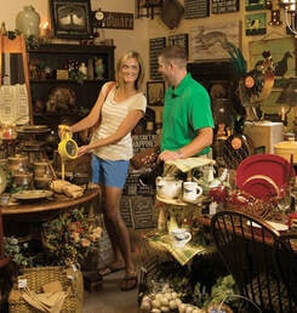 Florida - Whether you're a collector, a dealer, or just a buyer of decorative arts for your home or condo, scoring that perfect find while hunting through the backwoods and nether-regions of antique and vintage shops can often be a frustrating task. Especially when it comes to discerning the true from the fake, and the great from the pretenders. However, with a little help from some of the school's top appraisers and experts, we've managed to compile a list of items you'll definitely want to be on the lookout for this spring as you're out treasure hunting for those hot finds of the season. 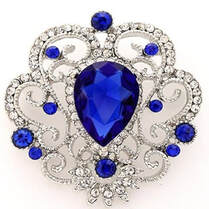 Costume Jewelry Like the school's annual survey pointed out in December of last year, there seems to be no end in sight for this popular collectible. Great deals can still be found and jewels don't have to be real. Look for known makers like Eisenberg, Trifari, Weiss, Sarah Coventry and Hobe - all can command top dollar. A boxlot investment of $20 at an estate sale can easily return $400 to $600 online.  Antique Purses This is something in the textile zone that you might really want to pay close attention to - it's already gotten hot, but we think it's probably going to sizzzle this upcoming year. Look for vintage beaded bags, MCM lucite purses, chainmail style clutches from the twenties and thirties, and anything that comes with bangles. As always, condition is paramount. Buy at $20, sell online for $350.  MCM Dishes & Chinaware While everyone is obviously aware of the incredible explosion of Mid-century modern into furniture design and tastes of the 21st century, it doesn't end there. Small little condiment dishes and place settings have also rocketed off the charts recently. Experts at the school say these can be a particularly good find since little dishes like these are often overlooked during an estate sale/garage cleanout.  Tin Toys While toys remain popular across the spectrum, most of the school's experts feel that tin toys are particularly well positioned to move up this year in price and popularity. Especially lithographed makes, and those related to robots and the space age. Dealers are scooping up $10 garage sale and estate sale boxlots and flipping for twenty times that online. Original box and packaging add value. 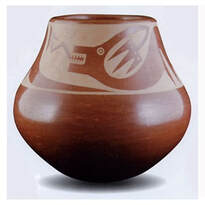 Pueblo Pottery For many, McCoy was the name, but recently others have begun to shine, and Maria Martinez may be at the vanguard of this movement. The Pueblo artist was a prolific creator, and her blackware pottery is plentiful and beginning to command sizable prices at auctions across the country. Again, look for unchipped and pristine examples in order to see the best realized price. 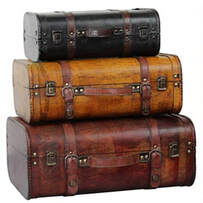 Vintage Luggage This is a rapidly rising area of interest for collector's and dealers alike. Old Pullman cases and mid-century modern themed pieces are flying out the door. As with all practical items, condition is king. Look for original leather straps, perfect linings on the inside, and if it comes with authentic travel stickers, so much the better. Vintage Vuitton and American Oshkosh pieces can bring very, very high prices. Look for accessories too, such as hat boxes. 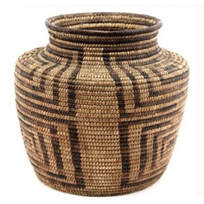 Native American Handicrafts It goes without saying that native American items of any kind are still very popular today, and will command top dollar prices at galleries and auctions. However, there are still a number of bargains to be had for those with a keen eye. Woven baskets are often missed at garage and estate sales, and at $2,000 to $40,000 a pop, they could be more like a lottery win for some. Look at the design and shape to help determine authenticity. 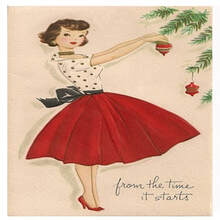 Christmas Memorabilia & Decorations While Christmas might not be on the mind of anyone at the moment, this is certainly one of the best times of the year for scooping up all those old unused vintage cards and ornaments, for resale in December. Tony Harper, one of the appraisers at the Institute, says he's noticed that Christmas cards with an MCM theme can sell in the $30 to $50 range for a pack of five. Classic tree ornaments with motifs that date the item can also prove highly desirable just before Christmas. 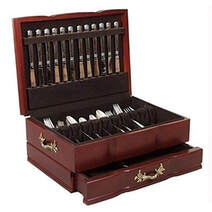 Flatware and Cutlery Sets Finally, to round out our top eight picks (plus 1), for antiques not to be missed, are flatware and cutlery sets. For a while, these items seemed destined to join the moniker of Victorian passé, but they've recently made a turnaround, and box-sets that could be previously be bought for $20 to $40 are now back in the triple digit range. Again, estate sales with downsizing as the main theme are likely going to be your best bet for good quality finds at decent prices.  D. Harman (AIA), is a former Asheford Institute honors graduate and a freelance writer who has a knack for picking trends when it comes to the decorative arts world. When away from his keyboard, Mr. Harman is also a top "picker" for some of New York's finest antique & art establishments. NOTE: For readers seeking more information about the Asheford Institute Of Antiques distance-learning program on professional-level appraising, the study of antiques, collectibles, vintage and mid-century modern items, please click here to visit the school's Home Page.
Should you have additional questions about the Asheford program, you can also write to the school at: [email protected] or call the Registrar's Office toll-free at: 1-877-444-4508. 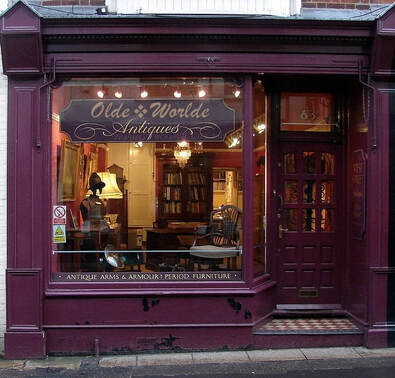 Classic Imagery From A Bygone Era? Classic Imagery From A Bygone Era? Florida - Understanding what's hot and not these days in the antiques market seems to be as perplexing a question as ever. Years ago, the ancient, and likely scholarly owner of the local antiques store was often the go-to resource for what to buy. For fine well established items that would almost certainly accrue in value, Georgian furniture was the way to go. For those less well-heeled, a solid investment in Victorian would likely reap rewards at a later date. For the younger set, primitives were in demand, and all the rage. Fast-forward thirty years, and the quintessential notion of an antiques dealer has undergone a massive make-over. Not just in the sense of image changing inventory, but from the ground-level up. No longer are antiques shops filled with brown wood, and men of academia representing a certain age. Instead, you're just as likely to encounter young hipsters handily working on upcycling old furniture into vibrantly painted colors slated for a showroom floor. For many in the business this change seems almost implausible. The long-standing image of the bespectacled antiquarian hovering over a magnifying glass in a musty old antique shop, has persisted for so long that it's virtually become enshrined as decorative arts lore, and a somewhat de facto representation of the antiques business itself. However, as with any industry, change is bound to happen. Just ask Ahmed Patel, a second-generation antiques dealer from Boston who recalls taking over his father's business fifteen years ago. "I'd pretty much worked alongside him my whole life," says Patel, "but when I finally took the reins, I knew it was going to be a changing of the guard, in virtually every sense of the word." Patel remembers telling his father they should maybe try some new ideas, as shop sales of old European classics had begun to falter by the turn of the century. "He was reticent to change," says the younger Patel, "He just wanted to believe it was a temporary downturn." The elder Patel was not the only dealer during this period to express such resistance. Janet Hawkes, a now retired antiques dealer from New England, recalls how she thought the exact same thing in 2000. "I simply attributed our lack of sales in early American furniture to the dot-com bust of the time, but in reality, it just never came back," says Hawkes. 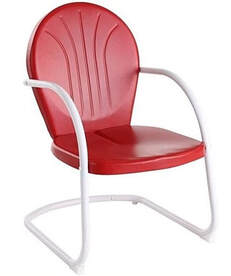 Garden Furniture Garden Furniture Patel thinks that much of his father's resistance to change was due in large part to the consistency that the antiques trade had witnessed over the last forty years. "He definitely had a few ups-and-downs in that time, but for the most part it always came back - and usually to the same type of items." Garden Furniture Hawkes noted that when she and her husband retired in 2006, they had finally pivoted to more kitschy and vintage themed pieces for their shop. "It was actually working really well," she says, "But it was simply time for us to call it a day." Relinquishing control to her daughter in 2007, Sarah Hawkes moved the business even father from traditional mainstream antiques, and began to include vintage clothing and accessories. "It was a super seller right from the start," she said, "...and continues to be so." Later that same year, while hunting down inventory, the younger Hawkes started adding vintage garden furniture on the side, doing a light refurb where necessary, and placing it outside the storefront in the mornings during the summer months. "It was all I could do to keep pace," says Sarah, "by the late afternoon, it was usually sold - especially on sunny days." When Patel took over his father's business in 2004, he began to implement new changes almost immediately. "The first thing I actually did was to open up a wall and put in some windows to bring more light into the shop," says Patel, "The next order of business was to start buying inventory based on what people from my generation were collecting." Patel says it wasn't hard to see that stainless steel influenced themes in the kitchen were leading to mid-century modern décor. "I was literally buying it by the truckload for $20 to $50 back then. Often times on a Sunday I could travel the neighborhoods and find enough free curbside inventory to last a month." Sales were brisk according to Patel, and within a few years he could barely keep up with demand. "It was definitely the right decision for the time," he says. Today, Patel and most other dealers in his neighborhood all carry a very similar stock and inventory of MCM and vintage themed pieces, which Patel says he finds worrying. "It's not like my fathers' generation anymore, where we can sit and rest knowing what's popular today, will probably last a lifetime - it won't." Patel thinks the antiques business is just like any other retail business now, "Unfortunately, we're going to be subject to the whims of popular trends and change like everyone else - whether we like it or not - so we're probably best to start adapting now..." - A.I.A. Staff Writers NOTE: For readers seeking more information about the Asheford Institute Of Antiques distance-learning program on professional-level appraising, the study of antiques, collectibles, vintage and mid-century modern items, please click here to visit the school's Home Page.
Should you have additional questions about the Asheford program, you can also write to the school at: [email protected] or call the Registrar's Office toll-free at: 1-877-444-4508. 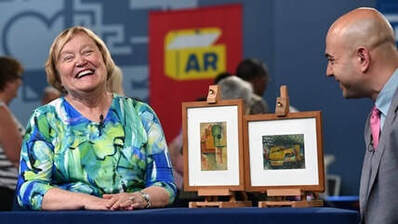 Florida - We've covered this story in the past, but it would seem that our friend Keaton Patti is up to his old tricks again when it comes to spoofing the iconic Antiques Roadshow nameplate. As we're sure everyone is aware, the Roadshow has been responsible for handing out informative and on-air appraisals about rare and unusual antique and collectible items for many decades now. The show's incredible popularity has spanned the globe with various clones of itself popping up in Canada, Sweden, Australia, and of course the USA. However, it wasn't until an Internet meme artist started having some fun with the classic "valuation still-shot" at the end of each segment that the show finally hit its full Internet potential back in 2016. Fast-forward to 2019, and photoshop specialist and salient meme humorist, Keaton Patti, is at it again, as he takes legitimate freeze-frame photos from Roadshow appraisals (shown above), and turns them into fake one's for our viewing pleasure (shown below). So, without further ado, here are a few of what we think might be some of the funniest fake appraisals memes of the Antiques Roadshow that we've ever seen... Antiques Roadshow Memes:         There are of course many more of these types of memes online (not all "G" rated however), but we thought these eight particularly represented the ethos of the Roadshow quite well, while simultaneously giving a wee chuckle. However, if you've managed to come across a few more you think should also be included, or have one yourself, please let us know, and we'll be happy to take a look for our next go around... - A.I.A. Staff Writer's NOTE: For readers seeking more information about the Asheford Institute Of Antiques distance-learning program on professional-level appraising, the study of antiques, collectibles, vintage and mid-century modern items, please click here to visit the school's Home Page.
Should you have additional questions about the Asheford program, you can also write to the school at: [email protected] or call the Registrar's Office toll-free at: 1-877-444-4508.  "New" Mid-Century Modern Chaise Being Offered On Wayfair and Amazon "New" Mid-Century Modern Chaise Being Offered On Wayfair and Amazon Florida - For many years now, antique dealers and vintage sellers have watched in amazement (and to a certain degree, dismay), as the styles and tastes of the buying public have seemingly turned on a dime. What were once stalwarts of the antique industry; Victorian, rustic, early American, and silver, have all given way to more futuristic constructs, from mid-century modern to the more recent vintage and retro infused themes of the 60s, 70s, and 80s. And yet, while many of these recent trends have sailed past the popularity barriers of niche collectors, and into the mainstream markets of such giants as Wayfair and Amazon, it is these old flavors from yesteryear that are now raising an eyebrow amongst some of the country's top decorative arts specialists - many who worry about the lack of new and original styles being created today, for the potential collectors of tomorrow. Or, as Terrence Henessy, a young furniture designer from Los Angeles put it, "Are we creating any new trends for our own generation, or are we simply rehashing familiar designs from the past?" For many, cultural motifs of the time such as post-war modernism and space-age futurism were once the impetus for change within popular styles of the decorative arts, but today there's a feeling we're simply recycling old ideas - while adding only marginally new twists onto variations of a theme, says Rocko Jacques, an interior designer from London who works both sides of the pond. "We copy the mid-century motif instead of creating a new one." Retailers such as Wayfair are not mirroring fresh new ideas and designs reflected in the social and technological advancements of the day, but instead are simply copying and producing what's popular with those in the vintage and retro marketplace. According to Jacques, websites such as Etsy, along with millions of other entrepreneurs selling their vintage wares online, have become the barometer for what's trending, "They're not just reflecting popular tastes and style, in so much as they're creating them," said Jacques. "This is where the new design trends are coming from - they're not really original - but rather just recast from years gone by." Henessy, who echo's many of Jacques thoughts, also noted that while some of the pieces in his LA design shop utilized the curvy plastic look from the seventies, he tries to keep the "borrowing" to a minimum. "The decorative arts style of the early 70s with it's modular design, egg-shaped chairs, and heavy use of wrap-around white plastic was completely new and based on the futuristic themes inspired by the space race," says Henessy, "To copy it too completely is not paying homage to those great original designers, but instead is really just ripping them off." For some, the trend-setting variance is simply a matter of degree. Where designers once took their cues from large changes in the social and political movements of a time, such as the space race, it seems that today we're left with a far different landscape. iPhones and the like can have an effect, but it's not as transformative in the way it once was. IBM gave way to the notion of real computers in the 1960's, and the public's imagination soon followed - all the way to the silver screen - with films like Space Odyssey 2001 and the nefarious HAL computer, which not only inspired a generation of tech geeks (think Bill Gates), but trickled down to fashion and décor with uniform style pant-suits, and modular spaceship furniture. The seventies became a generation inspired by its own time - not the other way round. For many in the decorative arts field, there's a strong sense of optimism that something fresh and new might be looming just over the horizon - a renaissance of spirit and original design. Whether this generation can salvage its own unique and iconic trend-setting style remains to be seen. "I wouldn't necessarily bet against it," said Jacques. However, when presented with a recent article from a top design school that showed seven out of ten students chose mid-century modern as the most influential trend of the time, Jacques responded, "Well, I guess we've got a way to go then..." - AIA Staff Writers NOTE: For readers seeking more information about the Asheford Institute Of Antiques distance-learning program on professional-level appraising, the study of antiques, collectibles, vintage and mid-century modern items, please click here to visit the school's Home Page.
Should you have additional questions about the Asheford program, you can also write to the school at: [email protected] or call the Registrar's Office toll-free at: 1-877-444-4508.  Florida - The latest results from the Asheford Institute's yearly annual survey of top buying trends within the antiques, vintage and collectibles community was just released by the school this past week. The Institute, which has been conducting the industry related survey for over ten years now, uploaded its latest trending data on decorative arts sales for 2018 via a dedicated page on the school's web site. The survey, which focuses on compiling and grouping information related to customers buying habits over a twelve month period, came about as a result of strong interest from readers requesting updates from previous surveys, said current Director of the Institute, Charles Green. He went on to note that there were some interesting changes in the poll results this year. "Our questionnaire has become more detailed, resulting in answers that are more period and genre specific. We're really able to drill down now into the types of antiques and vintage items that are actually selling well within a 12 month period." Green also acknowledged that the increase in poll-participants (up 15% over last year), had led to more accurate survey numbers in regard to particular sales categories. "More data has simply given us better survey results," said Green. The school's lead Poll Researcher, Anthony Harper, echoed Mr. Green's sentiments and went on to say that the main goal of the Institute's survey was to provide meaningful analysis of measurable interest in current trends within the antiques and collectibles marketplace, based on actual sales results and requests for specific items from customers. Harper, who has worked on eight of the school's past polls, noted that while the survey was based on a general series of questions, and did not employ any standardized formulas, the overall results were still very revealing when looked at as a whole. “The shift in what's considered collectible is continuing to change, and at a more accelerated pace than before," said Harper. "For the last few years it's been Mid-century modern, but this year we're beginning to see some challenges to that dominance." Some of the other highlights from the poll included a resurgence of all things Western. "We're seeing a revitalized interest by the public in literally anything related to the American past and particularly the wild, wild west" said Harper. Other top sellers on the school's list include a few industry standards such as Star Wars items, space related toys from the 1960s and 70s, as well as automobilia and related mechanical items. Harper noted that just as in past polls, the most noticeable change in collecting genres was being reported by younger dealers, who indicated that consumer tastes seemed to be trending towards virtually anything related to the latter half of the twentieth-century. "The reality is the younger collectors are the one's moving the ball forward now," said Harper, "the rest of us just appear to be along for the ride." For readers wanting to view the full results of the Institute's 2018 survey, you can find them online at: https://www.asheford.com/2018-survey-results.html - A.I.A. Staff Writer's NOTE: For readers seeking more information about the Asheford Institute Of Antiques distance-learning program on professional-level appraising, the study of antiques, collectibles, vintage and mid-century modern items, please click here to visit the school's Home Page.
Should you have additional questions about the Asheford program, you can also write to the school at: [email protected] or call the Registrar's Office toll-free at: 1-877-444-4508.  Florida - eBay is arguably one of the best known brands in existence. From their "mythical" start as a Pez dispensary and listing site for the founder's wife, to their position as one of the world's largest online sellers of antiques and vintage items, this company has managed to solidify its global reputation as the auction site that simply sells "everything." Over the decades, countless millions of people have sold antique and vintage items across eBay's online platform, and in the process, have provided eBay with a veritable treasure trove (or so it would seem), of data regarding the sale of such items as they've passed under the company's online hammer. Realizing the value of this information, eBay was quick to offer its buyers & sellers free access to the data as an enticement to return and put more items up for auction. As eBay's stature grew over the years, the notion of determining the value of one's antique and vintage items by comparing them to eBay's online listings became commonplace. The refrain, "Oh, I saw one on eBay for exactly the same price..." became the standard definition for evaluating literally anything. Unfortunately, as many people found out, this criteria simply didn't hold up when it came to bricks and mortar businesses, nor did eBay's "realized" prices necessarily reflect regional and geographic differences in taste, or the fact that clicking a mouse at an online auction didn't always mirror real world auctions or their prices. Over time, it became clear to many dealers and collectors that you'd not only have to take eBay prices with a grain of salt - but you might need the whole shaker too. 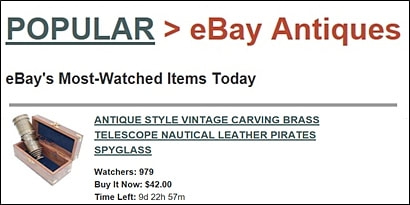 Antique "Style" (Ilus.1) Antique "Style" (Ilus.1) Fast-forward to 2019, and dealers and collectors are once again questioning the value of some of eBay's public data sharing's. One such example, a recent listing showing the "most watched items" under eBay's heading of Popular Antiques, is of particular concern since many of the actual items aren't even antiques at all, or vintage for that matter - they're new. Now while most dealers and collectors and even astute punters can figure this out by simply reading the title, what's distressing is the rest of the buying public may not be as savvy to this clever wording as the pros. However, leaving the semantics aside, what's even more of a concern is that the listing is factually incorrect. If you use the example of the snapshot from the picture cited in Ilus. 1, it turns out that six of the top ten antique items reportedly "being watched" on eBay from that particular day, were in fact not even antique, nor were they vintage. Now we realize that you can probably refine the search on eBay, using filters to gain more accurate listings based on what you're searching for, but when the sites overall heading related to antiques, and the type of items people are "most watching" are not antiques, it should give one reason to pause - or at the very least - reconsider the information being presented. There are of course plenty of reliable stats that can likely be gleaned from using eBay's free data collection offerings, but the aforementioned case raises the spectre of exactly how much one should completely trust this information when it comes to making antique purchases of your own. If getting solid intel on what to buy for your business is paramount, then one should not only consider the source before making any sizable investments, but how that information was arrived at. As with literally all things in life, the proof is often in the pudding. So when it comes to the reliability of "free" information being listed by one of the biggest online retailers of antiques and collectibles in the world, perhaps a modified quote from Edgar Allen Poe might sum it up best, “Believe nothing you hear, and only half (or less) of what you read..."  - Annie Smith, A.I.A., PACC (*Ms. Smith is a guest writer for the school, and syndicated antique & appraisal columnist who has been covering the decorative arts beat for over thirty years. Ms. Smith's views and opinions are her own, and do not necessarily reflect those of the Asheford Institute). NOTE: For readers seeking more information about the Asheford Institute Of Antiques distance-learning program on professional-level appraising, the study of antiques, collectibles, vintage and mid-century modern items, please click here to visit the school's Home Page.
Should you have additional questions about the Asheford program, you can also write to the school at: [email protected] or call the Registrar's Office toll-free at: 1-877-444-4508. 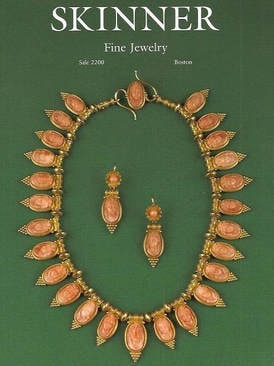 Florida - Just in case you were wondering, sales of antique and vintage jewelry continue to remain hot - extremely hot - as this week will likely mark an extravaganza of bidding up and down the east coast at some of the world's leading auction houses. In addition to the heavyweights, a number of smaller online venders also plan to get in on the action by offering significant sales of their own. While not quite the Black Friday of general retail, this amalgamation of jewelry auctions occurring over a twelve day period in December is nevertheless an impressive event. Sotheby's, Bonham's, Christie's and Skinners are but a few of the major players who'll be moving a stunning collection of jewels and precious metals across the auction block this week. Collections from a number of prominent woman and early period pieces from notable antique dealers, will feature heavily in the sales. However, it's Skinner's "Important Jewelry Sale," that will likely garner the most attention from those interested in precious stones and settings from the past. Over the years, the Boston auction house has earned a reputation for locating rare and authentic period jewelry. Attendee's of Skinner's auctions are keenly aware of the house's ability to source some of the best historical jewelry out there, which is well reflected in their catalogs, and by the prices realized at their auctions. A major part of their sale this week will include 96 lots from the collection of Edith Weber - one of the country's top dealers in antique jewelry. Weber who started her company in 1960, quickly became one of Manhattan's most sought after dealers, and the person you called when looking for rare jewelry from the past. Aside from her spectacular overall inventory, Weber was also widely credited with being one of the country's top experts when it came to antique jewelry. Some of the items from the upcoming sale will include: 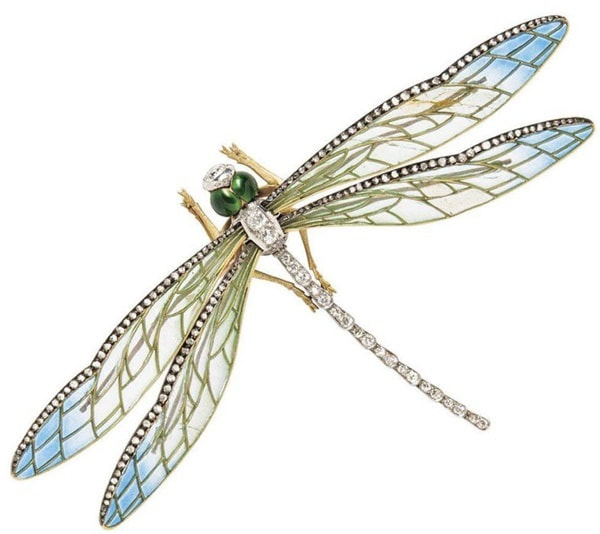 Art Nouveau Plique-a-Jour Enamel and Diamond Dragonfly Brooch. The plique-a-jour wings are edged with rose-cut diamonds, and are set en-tremblant, body and green enamel head, set with old European, old mine and old single-cut diamond melee, engraved legs, silver and platinum-topped 18kt gold mount. Estimate: $7,000-10,000 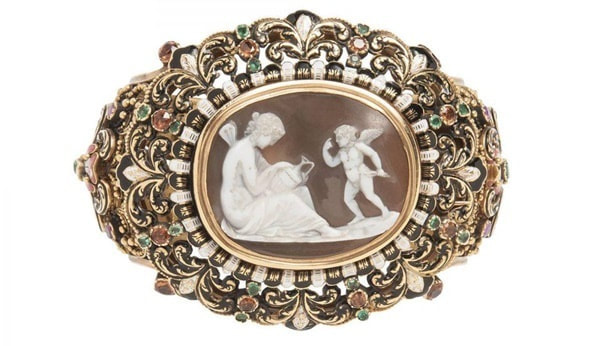 From the mid-19th century, this oversized cameo-bangle with hinges, depicts Cupid and Psyche, framed by polychrome enamel scrolls, with bead and wirework, enamel flowers, and colored stone. The central cameo is removable for brooch conversion. Estimate: $5,000 - $7,500 However, it wasn't just Judith who had an eye for the bangles. Weber's son Barry, who joined the company in 1975, along with his wife Sonja, had learned the jewelry trade early on from his mother, and went on to become one of the most respected appraisers on the Antiques Roadshow for almost fifteen seasons. Edith's jewelry pieces were often seen at black-tie affairs such as the Academy Awards, and were also displayed prominently in national advertising campaigns across the nation - all of which furthered the image of the family's impressive influence over jewelry couture, and their reputation as some of the world's top antique jewelry evaluators. This month's auctions will no doubt garner wide attention from the mainstream media, which in itself is a testament to just how popular antique, and even vintage jewelry, currently is with the buying public. However, if one were examine the contents of each sale with a careful eye, as to style, grace, and overall beauty, then it's likely one auction would rise to the top. To that end, we thank Ms. Weber for being such a stalwart in the advancement of beautiful antique and period piece jewelry - collectors everywhere owe you a debt of gratitude. - A.I.A. Staff Writers NOTE: For readers seeking more information about the Asheford Institute Of Antiques distance-learning program on professional-level appraising, the study of antiques, collectibles, vintage and mid-century modern items, please click here to visit the school's Home Page.
Should you have additional questions about the Asheford program, you can also write to the school at: [email protected] or call the Registrar's Office toll-free at: 1-877-444-4508. 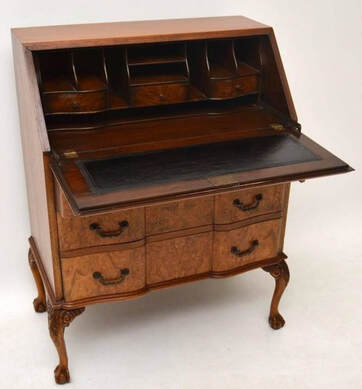 Bureaus No Longer Viable? Bureaus No Longer Viable? Florida - For many in the decorative arts community, one of the most common conundrums faced by business owners these days usually boils down to one simple concept; "What type of inventory should I be investing in so as to appeal to today's modern family?" The contemporary family home has changed dramatically over the last thirty years, and knowing what decorative items to fit into this changing lifestyle has become a challenge for many in the antiques and vintage trade. Pieces such as bureaus, or fall-front desks, which were used for writing and storing letters, and which were once staples in many homes, have now become virtually redundant, since they are no longer practical for today's wired devices (unless of course you're willing to drill holes into the back of them - ostensibly destroying their value in the process). In a recent study about modern families published by the University of California Los Angeles (UCLA), it found that most family time was spent today around the kitchen table than in any other room, with the den being the second most used, whereas the living room and dinning room were almost non-existent when it came to usage. As a corollary to this data, many auction sites "realized prices" over the last ten years, tended to back up the university's assertion, by indicating a strong drop in price and demand for formalized dining room tables and sideboards. As one employee from an auction house in northern California noted, "We tend not to see people sitting down to traditional style meals anymore - so I guess the need for matching tables and serving stands isn't going to be there either." However, the news isn't all glum, as a number of auction houses reported that while sales of formalized furniture for specific rooms was down, pieces that could be adapted to more modern home motifs were up, way up. Terry Smith, an auctioneer from New Hampshire, who sells primarily to customers in New York, said that rustic pieces, such as harvest tables, that could be incorporated into the new larger more modern kitchen spaces were selling well. "Old pine and early American straight-legged tables in the five to six foot range were moving fast," said Smith. "I think it's probably because their clean and simple lines work well with contemporary styles." Other items that Smith said were selling well included, blanket boxes, pine benches, and other primitive items that were practical in nature. 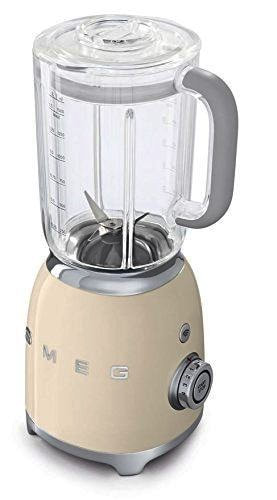 50's Blender 50's Blender Of course for those in the business who are dealing in the mid-century theme, sales continue to be brisk for almost all items within the genre. Gail White, who owns a mid-century depot for kitchen wares from the 1950's, says that she sells almost exclusively to designers and decorators who are looking to compliment their clients new modern kitchens. "Five years ago, it was just the mid-century pieces, but today, I'm literally selling out of anything that has even the smallest modern vibe to it - all the way back to Art Deco." For many, such changing tastes within the decorative arts field can often be difficult to get a handle on, since they often seem to occur as minor shifts within an existing genre, rather than an overall change in market direction and taste. Or, as one antique mall manager from Texas noted, "One day we're selling old, and the next it's modern, but old!" For the majority of dealers out there however, such news is simply part of the evolving marketplace, "I've learned to adapt," said White of her mid-century kitchen emporium. "At one point I was selling wooden rolling pins from the Victorian era, now I'm selling space-aged blenders from the fifties." - A.I.A. Staff Writers NOTE: For readers seeking more information about the Asheford Institute Of Antiques distance-learning program on professional-level appraising, the study of antiques, collectibles, vintage and mid-century modern items, please click here to visit the school's Home Page. Should you have additional questions about the Asheford program, you can also write to the school at: [email protected] or call the Registrar's Office toll-free at: 1-877-444-4508. 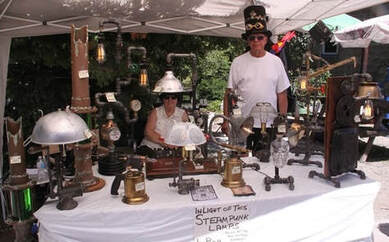 Vendors Selling Steampunk Inspired Lamps At Festival Vendors Selling Steampunk Inspired Lamps At Festival Florida - We've all heard the call to arms before, "Brown furniture is back!" Or, "Wood makes its return!" But the truth of the matter is that Mid-Century, and the overall modernist theme, is still very much in charge of today's decorative arts marketplace. Vintage is of course riding shotgun to this trend, while offering a wider scope of interest than simply adhering to the sensibilities of the modernist motif. And yet, as we've been reporting over the past twenty-four months, even with the market's Mid-Century dominance of the last few years, there are now fledgling signs that cracks may be beginning to form within this mantle. In April of last year, writer's at the Institute broke a story about how a substantial number of younger dealers were noticing a trend-shift towards modified brown furniture that had been absent up until this time. Many of these dealers commented on the fact that the trend seemed to focus on an adaption of old styles blended with new - a Duncan Phyfe style sofa for example - reupholstered in a modern theme. Or, the use of industrial pipes and fittings in the construction of old-wood style harvest tables.  Coldwater Steampunk Festival Coldwater Steampunk Festival Recently, many of these same dealers (in a follow-up questionnaire sent out by the Institute), went a step further in their assessment of today's changing market tastes; commenting that since last year there had been an even greater move by customers towards buying heavily modified pieces, in what many dealers were simply calling the "Steampunk" effect. As Allen Johnson, a dealer from Maine, who also crafts his own creations noted, "It was simply crazy; any Victorian furniture that I could add some industrial effects onto sold almost immediately." Steampunk, which has often been described as a type of industrial design and fashion, combining Victorian elements and sensibilities, with a Jules Verne style steam-driven utopia, appears to have transitioned from merely being a decorative arts niche, into something far more mainstream. In what many perceive as a societal rebuff and revolt against the modernist themes currently associated with the Mid-Century ideal, Steampunk is a growing movement that seems to somehow capture both the old and the new into one fantastical genre. Denise Orland, a dealer from the south side of Baltimore, echoed this sentiment in her comments when she noted that her husband had gone from refinishing to recreating pieces. "Our business model has literally swung 180 degrees in the last year," said Orland, "We're not only building Steampunk bespoke pieces for clients, but we're attending Steampunk festivals all around the world that combine everything from fashion to furniture to handmade decorative items - often sourced from old Victorian pieces - it's a wonderful mish-mash of ideas and design." 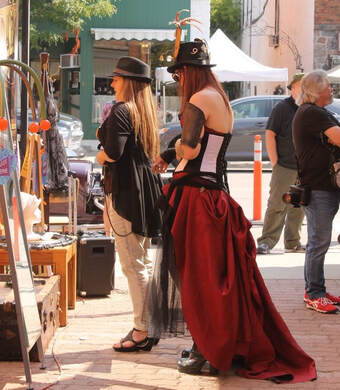 Living The Steampunk Lifestyle Living The Steampunk Lifestyle Another Canadian dealer, who curates a shop on Etsy, took her love for all things Victorian to the next level by literally enveloping her lifestyle within the Steampunk motif. As a lifelong collector, Debby Purdy says she originally went from antique show to antique show looking for strange and unusual Victorian era items which were no longer in demand, but could be upcycled into something new. When she realized she wasn't alone in her endeavor, the bells started going off. "Suddenly lots of strangely dressed people started showing up looking to buy the same items I was searching for... I didn't realize it at the time, but these were the early Steampunkers." Today, Purdy says she's fully embraced the genre, right down to her wardrobe choices. "I guess you could say I live the Neo-Victorian or Steampunk lifestyle, although I'm not sure how affordable it's going to be in the future, as prices for some of the cooler items are definitely beginning to rise." Whether Ms. Purdy is a precursor of things to come or what's already been, can be difficult to say, as changing tastes within the decorative arts community are usually influenced by similar changes within society first. These are then transferred down the cultural-highway, and, if all the stars are aligned just right, you'll often end up with the creation of a unique style or motif that manages to cross all societal boundaries, while simultaneously imbuing itself within the contemporary fashion, art, and furnishings of the day. The question as to whether or not Steampunk can truly make the leap into mainstream culture remains to be seen, but if the response to our recent questionnaire on the subject is any indication, then we'd say it's likely a good bet that top-hats and petticoats might well be making a return... - A.I.A. Staff Writers NOTE: For readers seeking more information about the Asheford Institute Of Antiques distance-learning program on professional-level appraising, the study of antiques, collectibles, vintage and mid-century modern items, please click here to visit the school's Home Page.
Should you have additional questions about the Asheford program, you can also write to the school at: [email protected] or call the Registrar's Office toll-free at: 1-877-444-4508. |
AIA StaffWe're providing our students and reader's with the latest breaking news on events and happenings that we think might be of interest to both collectors and dealers alike. Including changes within the world of antiques, vintage, collectibles and appraising that might just have an effect on your bottom line. We're also interested in hearing from you - so if you've got a great newsworthy story, let us know, and you just might find it here! Archives
July 2024
CategoriesLegal Disclaimer: Extraneous opinions, statements and comments made by individuals represented within these posts do not necessarily reflect those of the Institute. The publication naming of specific business entities, organizations, and concerns, contained herein, in no way represents an endorsement or recommendation of services or products by the Institute. Publicly identifiable information contained herein (including, but not limited to contact information), has been intentionally limited where possible, due to privacy and legal concerns related to the digital dissemination of information through online means. All views expressed herein are those of their respective owners. The Institute is in no way responsible, financially or otherwise, for the accuracy or validity of statements contained within published posts from sources that originate and appear outside of the written and expressed views of those submitted by the Institute.
|
 RSS Feed